
This article is taken from the April 2026 issue of The Critic. To get the full magazine why not subscribe? Get five issues for just £25.
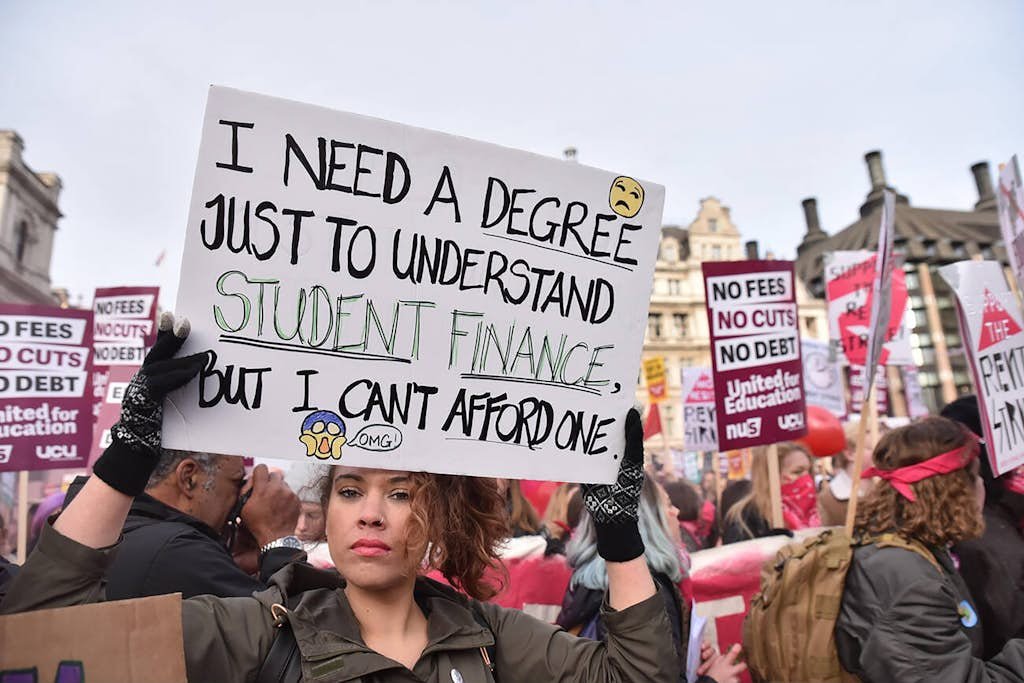
When I went to university, I supported tuition fees. This was not (solely) because I possessed the contrarian streak that makes someone a young Conservative, but because it made sense to me that somebody receiving a service — especially a service not deemed part of the State’s core responsibilities — should at least help to pay for it.
All these years later and I remain very much on the political right. Yet whilst I differ hugely from the “education should be free” brigade on the implications of abolishing tuition fees, I believe the system itself to be essentially indefensible. If you had to describe how they work to someone who knew nothing about them, and weren’t allowed to use the words “tuition fees”, what would you say? Here’s my effort:
“The use of taxpayers’ money and Klarna’s buy-now-pay-later business model to sell unconditional, high-interest, bankruptcy-immune mortgages to teenagers.”
Right-wing defenders of tuition fees sometimes describe them as the “free market” solution. But what we have just described is quite obviously, in economic terms, a demand pump. The state offers unconditional credit, on terms designed to short-circuit people’s cost-consciousness (a fact we recognise when the same tactics are used to sell handbags) for the purchase of tertiary education — and only tertiary education.
In fact, the entire system is essentially a series of demand pumps. The current student loan regime could hardly have been designed better if maximising demand were its sole objective. At every stage, the points at which demand for university education is generated are separated from points at which either any value in it is realised or is paid for.
First, prospective students are guaranteed the means to buy in to the system by the government. Second, the combination of student loans and the fee cap creates a university “market” with absolutely no price signals, removing another moderating influence on our spending habits. Meanwhile, universities are — or at least were, until recently — incentivised to offer as many places as possible, because the income from every student was guaranteed, and they take on none of the long-term risk that a particular degree doesn’t pay off for a student.
The glut of graduates produced by this system has led to employers increasingly making a 2:1 a requirement for entry-level positions that did not previously require a degree. This has the effect of increasing apparent “demand” for degrees, and forcing fresh generations of school-leavers onto the tertiary education treadmill. Finally, the tab for all this is split between young workers, on the hook for life for terms and conditions they signed up to years before, and eventually the taxpayer, which after a few decades is liable for the unpaid student loan book.
Few of the defences commonly offered for the status quo, beyond the basic principle that people should pay for services they use, stand up to scrutiny. Maximising the opportunity to go to university might be “aspirational”, for example, but aspiration has been a key ingredient in every financial scandal from the South Sea Bubble onwards.
Nobody seems to think that offering 18-year-olds a general credit facility is a good idea
If policymakers believe that 18-year-olds are capable of making a sound financial decision about borrowing £53,000 (which they must, if they think the student loan system is defensible) then why restrict that loan to purchasing degrees?
If school-leavers had the option of borrowing that money to invest in a business, or a house, or even put into a savings account, we might fairly say that whatever proportion chose to purchase university places with it reflected genuine demand. It would also be a bold policy response to the increasingly difficult economic situation facing young people.
❋
Nobody seems to think that offering 18-year-olds a general credit facility is a good idea. But if we don’t think they could be trusted to spend that money wisely, it becomes extremely difficult to justify making an exception for universities. The sector’s apologists tend to fall back on the idea that every degree, or almost every degree, is a good investment. But good investments don’t tend to require propping up by loss-making government loan schemes using predatory sales tactics.
They also point out that graduates earn, on average, more than non-graduates, which is true, and argue that this proves the value of higher education, which isn’t. The obvious thing such analysis fails to do is control for other variables. Geography, social class, intelligenc, and myriad other factors will all influence both someone’s lifetime earning trajectory and their likelihood of attending university. Once four-in-ten school-leavers attend, it is quite possible for a degree to be operating as a de facto licence-to-practise for white-collar work.
It is thus obviously specious to pretend that the earnings gap between graduates and non-graduates straightforwardly represents real value created by degrees — and when otherwise intelligent people are pretending not to understand that correlation is not the same as causation, you know that whatever policy they’re defending rests on very thin intellectual ice.
❋
If the student loan system is so iniquitous, the question becomes: why has it persisted? The answer, as so often when explaining the dysfunction of the modern British state, is that it is the product of politicians avoiding difficult choices and hiding the costs with creative accounting.
The choices in question all relate to how much tertiary education is actually a “public good” deserving of taxpayer support. This relates not merely to the overall volume of it but also such thorny specifics as which degrees, which institutions and — thorniest of all — which people deserve that support.
In this sense (and it is perhaps the most important sense) the two sides of the tuition fees debate reveal themselves to be on the same side. Those who defend tuition fees view student loans as necessary to supporting higher education on its current scale, and very few of the “education should be free” proponents accept that fewer people should go to university as a result.
Breezy declarations that all education is a public good serve to avoid exactly the same questions that tuition fees evade, at least intellectually. Whilst advocates of student loans might scoff at the utopianism of their opponents, their system is built on the same assumption. How else to justify the taxpayer underwriting every prospective student for any degree?
The sad truth is that the advantages that accrued to graduates when less than ten per cent of school-leavers went to university were never applicable to 40 per cent or more. The university sector was simply scaled more closely to the segment of society of which university was part of the typical life cycle, and much of the value it did create for graduates came from the opportunity to network within that relatively narrow pool.
The old university system didn’t call these opportunities into being, and the state-directed engorgement of the sector has not expanded them, and was never going to.
❋
A progressive programme aimed at giving those opportunities to people from a wider range of backgrounds is by no means impossible. In fact, we already did it, during the grammar-school social mobility boom in the 1950s. But progressives turned against that, because identifying which people are most deserving of limited opportunities involves identifying which people aren’t, and that is something about which we are today extremely squeamish.
Student loans afford policymakers what Michael Young saw as one of the chief advantages to them of meritocracy — that those who fail have only themselves to blame — whilst allowing policymakers to feel good about being non-judgemental.
But the subsequent bloat only entrenches middle-class advantage; far better for other people’s children to go to a second- or third-tier university than compete with your own for a place at a first-rate one. Employers (those you care about, at least) will know the difference; a school-leaver, especially one with no higher education in their family, may not.
Yet however tidy this arrangement seemed, it is gradually destroying the universities themselves. Young undergraduates increasingly act as if they’re paying for a degree, rather than an opportunity to learn, and are perfectly rational to do so.
Academics are faced with a larger, less engaged student population and an epidemic of cheating. Universities that crack down, or grade ungenerously, risk poor student satisfaction reports. Institutions pad their books with overseas students, and don’t pay too close attention to whether they attend class.
There is no painless way out of this mess. Much as apologists will howl, Britain’s public finances and political climate will not permit the sector to demand ever-higher levels of government spending (or immigration) forever. Any realistic policy correction is going to result in fewer places at fewer universities. But politicians squeamish about choosing where precisely the axe falls could at least take steps to correct the absurd misalignment of incentives which has created the problem.
Shifting student financing to income-sharing agreements with universities, for example, would mean that institutions had to take risks on graduates, and thus be more selective about which they took. Employers who insist they need graduates are really telling us their business requires expensive education currently paid for by the taxpayer and their younger workers. It is therefore employers, rather than graduates, who seem the most fitting target for a “graduate tax”, as it would mean they internalised that cost (and might perhaps start thinking twice about whether they really need that 2:1 after all).
Unfortunately for politicians, all of these groups have much louder and more effective lobbies than the next tranche of 18-year-olds, which is why successive governments for so long defaulted to mugging them instead.
But that strategy always had a sell-by date, for one simple reason: those 18-year-olds eventually grow up. And vote.