
A potential wave of foreclosures has begun near Temple University after some buyers who paid tens of millions of dollars in inflated real estate deals — at least on paper — stopped making mortgage payments.
Students and other renters in those properties could be caught in the fallout amid growing concerns of a possible mortgage-fraud scheme involving dozens of buildings in North Philadelphia.
The foreclosures, now moving through Philadelphia’s Court of Common Pleas, include two buildings on the 1800 block of North 18th Street, as well as properties on Willington Street and North Park Avenue, encompassing at least 11 apartments and 33 bedrooms.
The filings are the clearest signs of trouble tied to roughly $45 million in property deals clustered around the campus, where a small group of buyers — all connected to a single real estate agent — overpaid for student rentals, according to deeds and other public records.
The sales, beginning in late 2024, saw purchasers sometimes pay upward of $905,000 apiece, records show.
In reality, eight sellers or their agents previously told The Inquirer that they entered into the deals with the understanding that they would receive only about half that amount — closer to, or even less than, their original asking price.
Court records in the four foreclosures show that in each case a substantial amount of the borrowed money remains unaccounted for — the difference between the amount of the mortgage and what sellers actually received at closing. All four owners went into default within months of the purchases, the lenders say.
Nina Spizer, a criminal defense attorney who handles complex fraud cases at Dilworth Paxon, said the sales raise “a lot of red flags”
“A criminal case could be made simply from the fact that, say, I bought it for a million dollars and the seller only got $600,000,” Spizer said. “Unless the mortgage company signed off on that, but I’ve never seen that.”
Susan M. Wachter, a professor of real estate at the University of Pennsylvania’s Wharton School, said a tide of foreclosures could have far-reaching implications.
“The city loses out because these people aren’t going to pay their taxes,” Wachter said. “Constituents are hurt because they won’t maintain the properties. And eventually it goes into foreclosure and the tenants will lose their lease.”
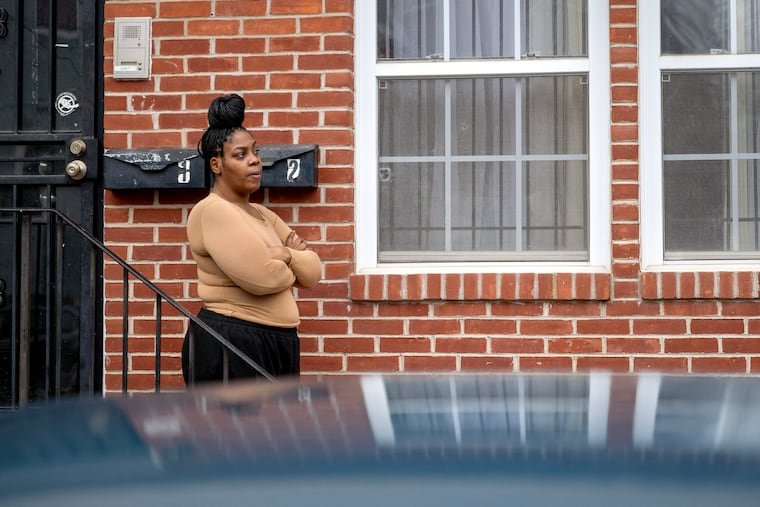
Shanese Dutton, 32, a social worker who lives in one of the Temple-area apartment buildings that received a foreclosure notice, said she’s worried that when she leaves for work or for grocery shopping the bank could change the locks and she and her two girls won’t be able to get back in.
“I’m confused,” Dutton said. “I don’t know what to do as a mother.”
The Inquirer first reported on the unusual deals around Temple in December. After years of declining student enrollment, dozens of once-valuable student rental properties had been listed for sale at an average price of $450,000. Some were under-occupied or vacant.
The properties spent months on the market unsold. Then, records show, a small pool of buyers represented by real estate agent Patrick C. Fay of Coldwell Banker set up limited liability corporations and signed deeds indicating that they paid about double the initial asking price. One of Fay’s clients had previously pleaded guilty to mortgage fraud.
With those higher sales prices, Fay’s clients were able to obtain mortgages of $700,000 or more.
At least two dozen other real estate professionals in the area helped Fay arrange the sales, including agents who represented the sellers. Some of those agents worked with Fay at his Coldwell Banker office in Old City.
An appraiser contracted to evaluate one of the sales previously told The Inquirer that Fay had pressured him to sign off on an artificially high sale value for the property but that he refused.
Fay, in an interview before the foreclosures began, said he did nothing wrong and has “an unblemished record” over more than 20 years in real estate. He did not respond to requests for comment for this story.
The properties facing foreclosure are owned by 18th Landings, Park Ave. Enterprise, Crescente Team, and Willington Partners. The managers of those companies, Miles Fambro, of Philadelphia; Nathaniel Hall, who has addresses in New Castle, Del. and Philadelphia; and Angel Rodriguez, of Trenton did not respond to requests for comment.
Similar concerns about inflated deals have also emerged in Baltimore involving more than 700 properties, about half which have since lapsed into foreclosure. The FBI is now investigating those sales.
Jon Hornik, executive director of the National Private Lenders Association, said the suspicious activity in Philadelphia and Baltimore has led some lenders to avoid financing deals in the impacted neighborhoods altogether.
“Everyone is looking at it with a magnifying glass,” he said. “Anything coming out of there is going to be scrutinized.”
Students left in limbo
Tori Camacho, an advertising major in her junior year at Temple, has shared a stuccoed three-story rental on Willington Street for about two years with several roommates.
Records show the three-unit property sold last April for $905,000 in a deal Fay brokered. The buyer took out a $700,000 mortgage for a property assessed at only $555,000.
After the sale, Camacho said Fay came to collect rent, even though she hadn’t signed a new lease with him.
Camacho said Fay asked her to pay rent though a web portal that listed an amount due that differed from what Camacho had agreed to pay under the terms of her earlier lease.
“It’s been super weird,” Camacho said. “We’ve gotten no information at all. We can’t even see our lease.”
Camacho said a man who identified himself as “Caesar Scott” later contacted her and said he was Fay’s assistant and would handle collecting rent. When The Inquirer contacted Scott via the number he had given Camacho, the individual who answered immediately hung up.
Camacho said she has been unable to get Fay to respond to maintenance issues. A water leak created a small hole in the ceiling, and another opened on the bathroom floor after her roommate stepped out of the shower and sunk into a soft spot.
“You could never reach [Fay],” Camacho said. “We’ve emailed him and called him. One time that he actually answered, he was like, ‘How did you get this number?’ … And then he changed his number.”
Still, the apartment was cheap — $1,150 a month, split four ways — so Camacho and her roommates resolved to stick it out and finish the school year.
But in February, U.S. Bank Trust National Association filed to foreclose on the property.
The company that purchased Camacho’s building, Willington Partners LLC, had defaulted on the mortgage less than seven months after purchase.
Camacho learned about the foreclosure from an Inquirer reporter. She said she’s planning to move.
Dutton, the social worker living in a Fay-managed property on 18th Street, is in a similar situation. Over the summer, she said Fay contacted her about paying rent to him, even though she has no lease with him.
“I don’t know who to believe,” said Dutton, who has intermittently lost heat and electricity and has relied on a hot plate to cook meals.
Dutton said her neighbors in three adjacent buildings — all purchased with Fay listed as the buyers’ agent — have received pre-foreclosure warnings after the new owners stopped making mortgage payments. Two of the four buildings in that strip have officially gone into foreclosure.
“There’s nobody to call for help or anything,” she said. “All this stuff started coming in the mail about these houses being in foreclosure.”
Uncertain future
Coldwell Banker’s national office said the brokerage cut ties with Fay in December and launched an internal investigation after The Inquirer’s first article on the inflated sales. The brokerage had no comment on the foreclosures and declined to give an update on its investigation.
Real estate listings show that Fay has since been working at the Keller Williams office in Moorestown, Burlington County. He brokered the $449,000 sale of a single family home, in Blue Bell, and on another property in Elkins Park that closed in March for $275,000.
A spokesperson for Keller Williams did not respond to requests for comment.
According to paperwork he gave at least one tenant, Fay’s property management company — identified as both FP Management and FPI Management — is located at the Glenview Corporate Center in Bensalem. A building manager said no company by either name is based there.
Kandis Kovalsky, an attorney at Kang Haggerty in Center City, said her law firm is eying Fay’s Temple-area sales as a possible civil-racketeering case given the pattern of borrowers defaulting on the mortgages so soon after their issuance.
“It’s like the buyers had no intent of even making the payments,” Kovalsky said. “If you stop paying almost instantaneously after the transaction, I think that is very indicative of intentional misconduct and fraud.”
Loans are often transferred after settlement, which could make it more difficult to determine who the ultimate victim is and whether the original lenders also knew that the selling prices had been inflated, Kovalsky said.
Following one of the 18th Street sales, for example, the original lenders sold the inflated commercial mortgage to a larger financial institution, which rolled the loan into real estate-backed bonds that were sold to investors.
Regardless, Kovalsky said, “It seems like the end result would be a lot of foreclosures coming.” The lenders, she said, “would probably be lucky to get 40 cents on the dollar. Whatever the loan is far exceeds what the properties are worth.”
Meanwhile, Temple University has offered assistance to students living in off-campus properties who may be impacted. The university estimates that at least 30 students are living in buildings purchased by Fay’s clients.
Jodi Bailey Accavallo, Temple’s vice president for student affairs, said students concerned about their living arrangements have been contacting the university. Staff have offered on-campus housing for interested students, she said.
“It’s deeply concerning for our students and our neighbors in the Temple patrol zone that are going through this,” Accavallo said.
She said students and their parents should take advantage of Temple’s Best Nest program, which identifies well-managed rental properties in neighborhoods around the university. Participating landlords are required to keep their buildings safe and up to code.
Of the Fay properties, Accavallo said, “None of those were listed in our Best Nest program.”
Inquirer staff writer Joseph N. DiStefano contributed to this article.