
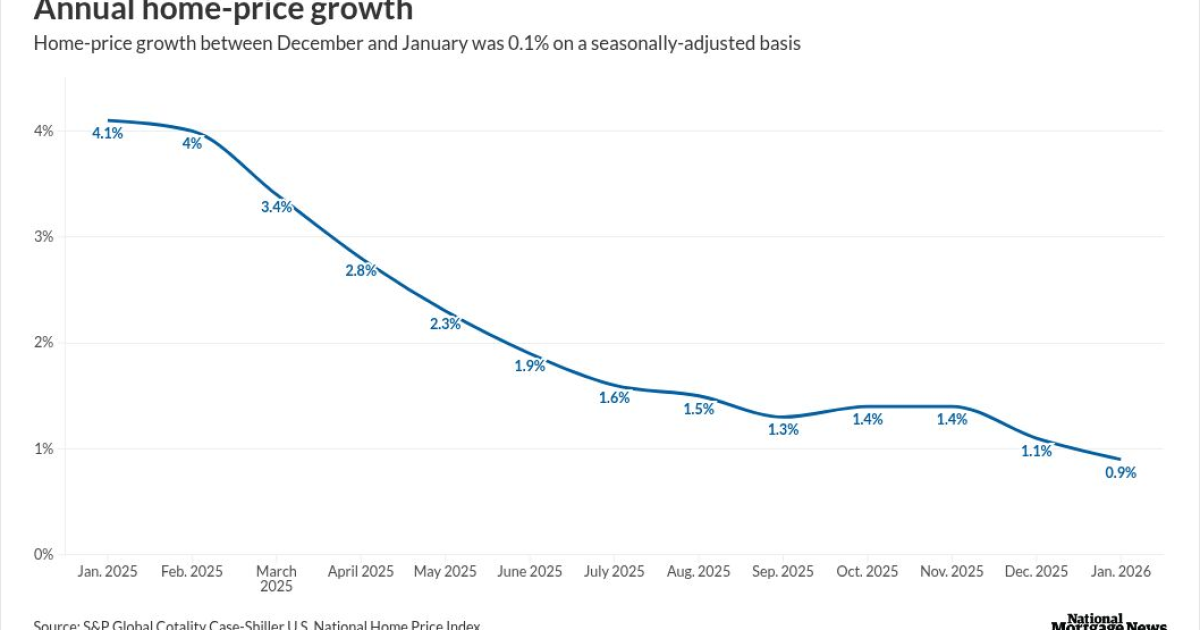
Home-price growth continued to slow to start 2026, two new industry reports found, diminishing the real value of homes as inflation rises.
Processing Content
Home prices rose 0.9% year-over-year and 0.1% month-over-month in January, according to the S&P Cotality Case-Shiller national home price index. Both points were
“Splitting the year into two halves sharpens the picture,” said Nicholas Godec, head of fixed income tradables & commodities at S&P Dow Jones Indices, in a press release Tuesday. “The national index rose 2.2% over the first six months of the period, then fell 1.3% over the most recent six, a swing that explains why annual gains have compressed to under 1% despite prices remaining historically elevated.”
U.S. Federal Housing’s home price index showed a similar trend. Prices climbed 0.1% month-over-month and 1.6% year-over-year, both decreases from their December counterparts.
The continuation of slow appreciation from the end of 2025 led to the weakest start to a year for home prices since the early 2010s, Bright MLS Chief Economist Lisa Sturtevant said.
Regionally, monthly home price changes ranged from a decrease of 0.7% in the West South Central division to an increase of 1.7% in the East South Central division, according to the FHFA. Annual changes ranged from a 0.8% drop to a 4.4% rise in the same two divisions.
New York saw the largest spike of any city on a yearly basis at 4.9%, followed by Chicago at 4.6% and Cleveland at 3.6%, while Tampa fell 2.5%, Case-Shiller’s report found.
January also marked the eighth consecutive month that inflation outpaced home-price growth in the United States, as the Consumer Price Index ran 1.5 percentage points above the 0.9% annual gain, moderately lowering the real value of homes, the Case-Shiller report said.
“While prices are up slightly on paper, the Consumer Price Index rose 2.4% over the last year and appears poised to rise further in the coming months,” said Stephen Kates, a financial analyst at Bankrate. “With 30-year mortgage rates remaining above 6% for the foreseeable future, buyers and sellers should expect a market that is challenged for growth. The position we are in today is neither recovering nor correcting sharply and buyers and sellers will both need to adjust to a new baseline of affordability.”
The 30-year fixed-rate mortgage
Following a moderate drop in rates in January as a whole, the 30-year rate dipped below 6% in February, prior to
“Affordability continues to be a major constraint on the housing market,” Sturtevant said. “Prospective buyers are waiting for both lower rates and slower price growth and are increasingly asking for concessions from sellers, leading to a more balanced negotiating environment between buyers and sellers.”
“Looking ahead, the outlook for the housing market remains cloudy,” Sturtevant said. “While there had been promising signs that affordability was improving, higher rates and growing uncertainty are creating headwinds in the market. Even with cooler demand, home prices are likely to be stable this spring due to the ongoing supply shortfall.”