
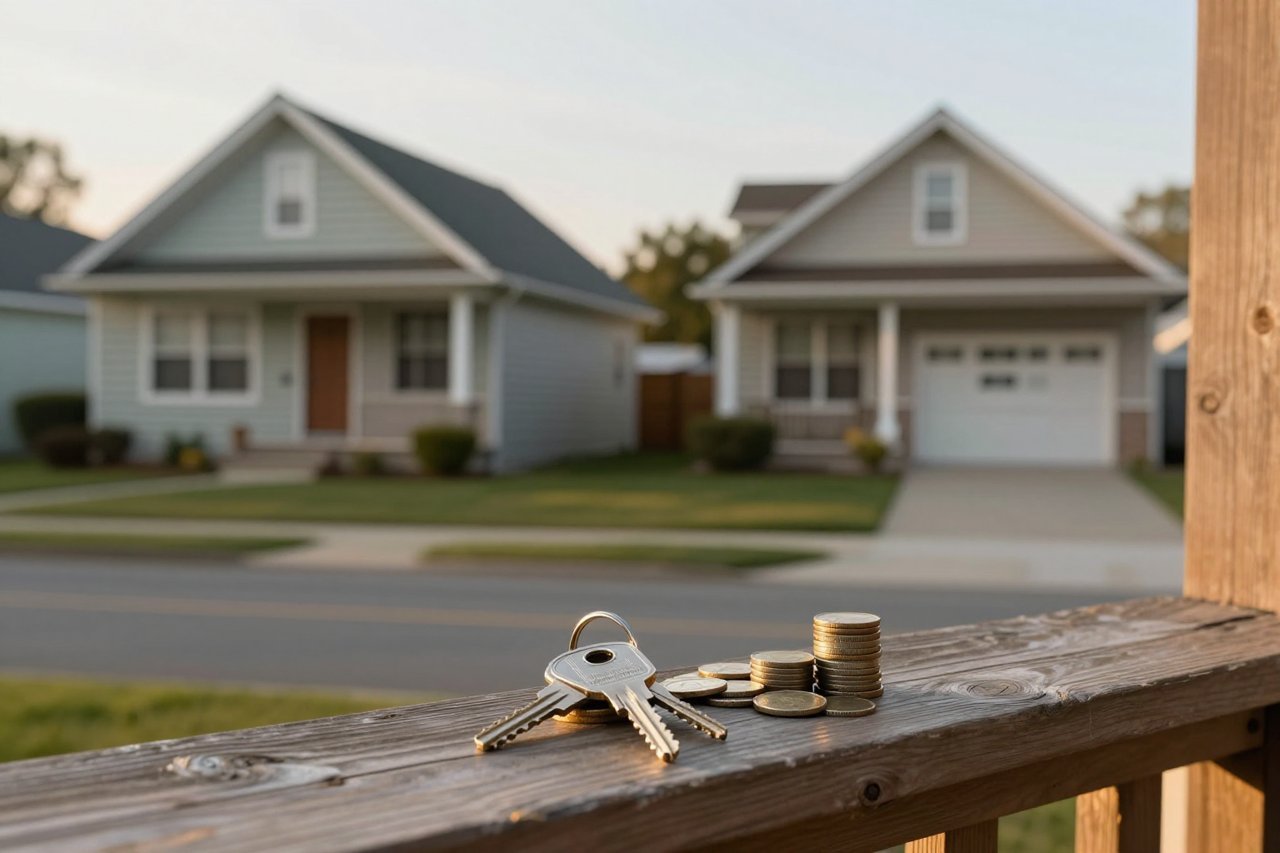
Picture two households buying similar $350,000 houses on the same street in the same week. One buyer uses a VA loan, the other an FHA loan. A decade later, one of them has handed over tens of thousands of dollars more in fees, and it has almost nothing to do with the mortgage rate they were quoted. That gap is why the VA vs FHA question matters so much to people buying their first home.
If you are new to all of this, here is the honest starting point. VA and FHA loans are both government-backed mortgages built to make homeownership easier than a plain conventional loan would be. They are not the same product. They do not cost the same, and the better choice usually depends on who you are rather than which loan is “better” in the abstract.
There is a short version of the full VA vs FHA loan comparison if you want the side-by-side summary. What follows is the version for someone starting from zero, with no jargon assumed.
Step One: Find Out Which Loans You Are Even Eligible For
This is the filter that decides everything else, and it eliminates the debate for a lot of people before they ever compare rates.
A VA loan belongs to veterans, active-duty service members, National Guard and Reserve members with qualifying service, and some surviving spouses. You need a Certificate of Eligibility, and you have to live in the home as your primary residence. If you don’t meet that bar, VA is simply off the table, no matter how good the terms look on paper.
An FHA loan is open to essentially anyone with a Social Security number, a documented income, and a credit score that clears the floor. The Federal Housing Administration insures the lender against loss if you stop paying, and that insurance is exactly why lenders are willing to accept lower scores and tiny down payments from FHA borrowers.
Where is that floor? A 580 credit score unlocks the standard 3.5% down payment. Between 500 and 579 you can still qualify, but you will need 10% down. Below 500, most FHA lenders will pass.
What Each Loan Actually Is, In Plain English
VA loans
The VA guarantees a portion of the loan, so the lender takes on very little risk. That translates into no down payment required in most cases, no monthly mortgage insurance ever, and a softer debt-to-income ceiling than most programs allow. The trade-off comes as a one-time funding fee instead of ongoing insurance.
FHA loans
The FHA insures the loan rather than guaranteeing it, and the borrower foots the bill for that protection. You pay it twice: once upfront, and then again every single month for as long as the loan exists. In exchange, you get access with a modest down payment and a credit score that would get you turned down by many conventional lenders.
The Cost Detail Most Beginners Miss
Both loans carry a fee that people tend to gloss over during the excitement of house hunting, and the structure of those fees is where the real money hides.
- VA funding fee: 2.15% of the loan for a first use with zero down, 3.3% for later uses, and 1.25% if you put at least 10% down. It is waived completely for borrowers with a service-connected disability. It is charged once.
- FHA upfront premium: 1.75% of the base loan amount, usually rolled into the loan so you never feel it leave your pocket.
- FHA annual premium: 0.55% per year, billed monthly. With 3.5% down your loan-to-value sits above 90%, which means this premium follows you for the entire 30-year term. It does not drop off.
That last bullet is the one that quietly reshapes retirement plans. A $155 monthly charge sounds harmless until you multiply it by 360 payments.
Running the Numbers on a $350,000 House
Concrete figures beat theory, so here is the same purchase financed both ways with a 30-year fixed rate.
FHA: 3.5% down is $12,250, leaving a base loan of $337,750. The upfront premium adds $5,910, so you are financing $343,660. At 6.5%, principal and interest runs about $2,172 a month. Add the $155 monthly premium and you are at roughly $2,327.
VA: zero down. The 2.15% funding fee adds $7,525 to a $350,000 loan, so you finance $357,525. Lenders often price VA loans a quarter point lower, so at 6.25% your principal and interest lands near $2,201. No monthly insurance, ever.
Read those side by side and a few things jump out. The VA borrower put nothing down and still pays about $126 less each month, roughly $1,500 a year. Over three decades, the FHA borrower spends close to $61,700 on insurance premiums alone, versus a single $7,525 funding fee. The VA household also keeps $12,250 in the bank on day one.
If you want to see how sensitive that math is to rate changes and down payment size, it is worth walking through the real math behind VA and FHA loan savings one line at a time. Small inputs swing the outcome more than most buyers expect.
Credit Scores and Down Payments in Practice
Scores above 700 make both loans comfortable. In the 580 to 660 range, FHA becomes the realistic path for someone without military service, and the insurance premiums are simply the price of admission.
VA lenders set their own credit minimums, frequently around 620, but the VA itself does not publish a score requirement. Residual income matters more, which is a calculation of what you have left after debts and living costs in your region. It trips up some applicants who assumed a good score was enough.
Where an FHA Loan Genuinely Wins
VA is not automatically the better loan for everyone who qualifies. There are real situations where FHA comes out ahead.
Sellers can contribute up to 6% of the purchase price toward your closing costs on an FHA deal, versus 4% on a VA loan. On a $350,000 house that is $21,000 versus $14,000, which can cover nearly everything you owe at the table.
VA property standards are stricter too. Peeling paint, a roof near the end of its life, or exposed wiring can stall a VA appraisal on a fixer-upper that an FHA appraisal would let through. If you are shopping the lower end of the market, that difference decides deals.
Entitlement is another one. VA borrowing power is finite and restored in specific circumstances. FHA has no such limit, so you can use it again and again.
How to Compare Offers Without Losing Your Mind
Rates are not published as a single number, and two lenders quoting the same loan can differ by half a point once fees and points are folded in. Ask each lender for a Loan Estimate on the exact same day, for the exact same loan amount and term, and compare the total cost rather than the headline rate.
If you want structure instead of guesswork, this step-by-step method for finding the cheaper loan walks through how to normalise quotes so you are comparing apples to apples.
A Half-Hour Exercise Worth Doing Before You Decide
Before you commit to either program, do this. Get your Certificate of Eligibility if there is any chance you qualify for VA, since it takes minutes online and settles the question. Then ask two FHA lenders and two VA lenders for Loan Estimates on the same property.
Add up four numbers for each: the monthly principal and interest, any monthly insurance premium, the upfront fee, and total closing costs. Multiply the monthly insurance by 360. That single calculation exposes the gap faster than any spreadsheet, and it usually makes the decision obvious within a few minutes.
For most veterans and service members, the VA loan comes out cheaper by a wide margin. For everyone else, FHA is a genuinely workable path into a first home, as long as you go in knowing that the monthly premium is permanent and plan your refinance strategy accordingly.