
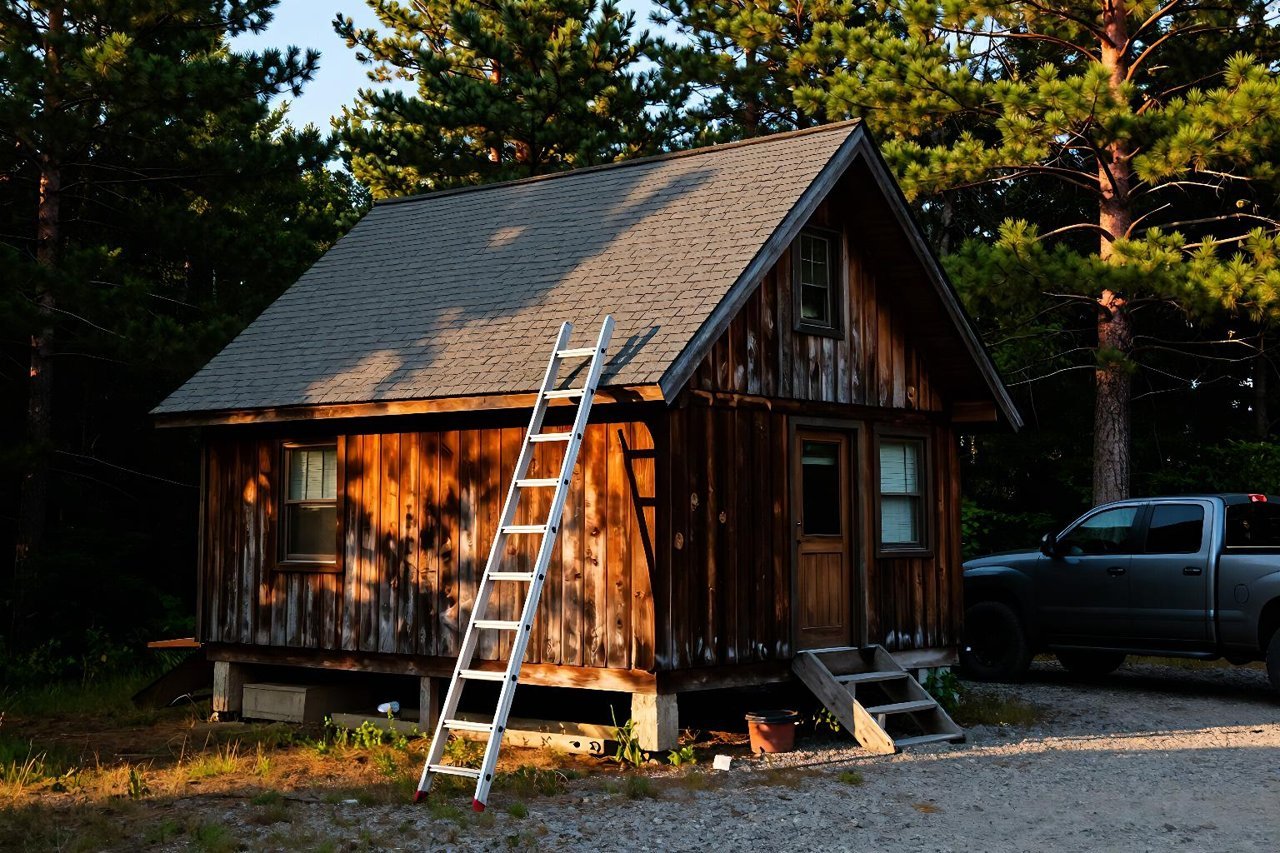
You bought the cabin four years ago for $310,000. It appraises at $445,000 now, the mortgage is down to $218,000, and the place needs a roof, a new septic field, and a kitchen that still has the original 1987 cabinets. A cash-out refinance seems like the obvious answer. Then the quote arrives with a rate half a point above your primary residence, a 75% loan-to-value cap instead of the 80% you’d get on your main house, and a request for six months of reserves.
None of that kills the deal. It just means the math on a second home runs differently than the math on your primary residence, and the gap is wide enough to change your answer.
What a cash-out refinance on a second home actually does
You replace the existing mortgage with a bigger one and pocket the difference. On the cabin: 75% of $445,000 is $333,750. Pay off the $218,000 balance, cover roughly $7,000 in closing costs, and you’d walk away with about $108,000. You don’t have to take the maximum either. A $280,000 loan would leave you roughly $55,000 after costs, enough for the roof and the septic without turning a repair list into a remodeling spree.
The catch is that you’re refinancing the entire balance, not just the $55,000 you need. If your current rate is 3.5% and the new one is 7%, you’ve just repriced $218,000 of cheap debt at a much higher number. That single fact drives most of the decisions below.
Second homes are priced as a riskier asset
Fannie Mae and Freddie Mac treat a second home as its own occupancy class. Expect a rate 0.375% to 0.75% above what you’d pay on an owner-occupied refinance, and expect that spread to widen if your credit is thin or the property is unusual, like a rural cabin with acreage and a well.
What pushes you into investment pricing
A second home has to be a one-unit dwelling you occupy for part of the year. It can’t be a 2-4 unit building, and it can’t be under a rental management agreement. Rent it 40 weeks a year and stay two, and you’re an investment property in everything but paperwork, with the pricing to match. Calling it a second home anyway is occupancy fraud, and lenders verify. They read tax returns, scan rental listings, check insurance policies, and look at the appraiser’s notes.
Loan-to-value caps shrink what you can pull out
Most lenders cap cash-out on a second home at 75% LTV. Some stretch to 80% with excellent credit and deep reserves. A few hold the line at 70% for high-value or rural properties. Investment properties generally sit at 75% too, just at a higher rate. If there’s already a HELOC on the property, combined loan-to-value is what counts, not the first mortgage alone. Working through how much equity you can actually pull from a cash-out refinance before you call a lender saves you a wasted application fee.
Credit, reserves, and the DTI ceiling
Second-home borrowers get underwritten harder than primary borrowers. The best pricing usually starts around a 740 score, 680 is workable, and below 640 the loan gets expensive fast, if it’s approved at all. Reserves are the bigger hurdle: figure two to six months of the new payment in liquid assets, sometimes calculated against both properties. A $1,900 payment with six months of reserves means $11,400 sitting in an account after closing. The credit score you need for a cash-out refinance moves the price more on a second home than most people expect, so pull all three scores before you shop.
The costs, in plain numbers
Closing costs on a cash-out refinance typically run 2% to 5% of the loan amount. On a $280,000 loan that’s $5,600 to $14,000, covering origination, appraisal (often $600 to $900 on a rural property with septic), title insurance, recording fees, and any discount points you buy. Plenty of it is negotiable. Cash-out refinance closing costs break down differently by lender type, and a broker quote with a 1% origination fee often beats a bank’s “no fee” pitch once you compare rates side by side.
Run the side-by-side before you sign
Second homes are one of the few situations where a HELOC frequently wins. Same cabin, same $55,000 need:
- Full refinance: $280,000 at 7.0% runs about $1,863 per month, and your 3.5% first mortgage disappears.
- Keep the first, add a HELOC: $218,000 at 3.5% is $979, plus $62,000 at 9% interest-only is $465. Total: $1,444.
That’s roughly $419 a month in favor of the HELOC, and you keep the low rate on the bulk of the debt. The trade-offs are real: fewer lenders write HELOCs on second homes, rates run higher, and a variable rate can climb. But if your existing first mortgage is under 4%, refinancing the whole balance to reach a small slice of equity is usually the expensive route.
Also worth pricing: a cash-out refinance on your primary residence, which gets better pricing and higher LTV limits, and a fixed-rate home equity loan on the second home if you want the new money locked in.
The tax detail that catches people
Interest on up to $750,000 of acquisition debt is deductible across your homes combined, so a second home qualifies. Cash-out proceeds are a different story. Spend the money on a boat or a car and that slice of the interest generally isn’t deductible. Spend it buying, building, or substantially improving the second home and it usually is. Keep the receipts, and get a CPA’s read before you assume the interest is a write-off.
Where this move earns its keep
A cash-out refinance on a second home works when three things line up: your current rate is close to the new one, you’re pulling a meaningful amount relative to the loan, and the money goes into the property or something with a return. Renovating a lake house that rents for $3,200 a week in July against a $900 winter baseline can pay for itself in a few seasons. The math on cash-out refinancing for home improvements holds up in that case and falls apart in plenty of others.
It rarely works as a debt consolidation tool. Rolling credit card balances into a 30-year loan secured by a vacation property stretches a two-year problem across three decades, and the cards tend to refill within eighteen months. If that’s the plan, read why paying off credit cards with a cash-out refinance so often backfires first.
One more thing to check: how far into your current loan you are. Refinancing resets the clock. Six years into a 30-year mortgage, you’ve built real principal. Roll that into a fresh 30-year term and you start from zero, which costs more than the rate difference suggests. A 20-year term or a smaller cash-out amount keeps total interest from ballooning past what you’re saving.
Get two quotes from lenders who write second homes regularly, one from a local credit union, and one HELOC quote as a control. Put the numbers in a spreadsheet and compare five-year total cost rather than monthly payment. That’s the figure that tells you whether the equity sitting in the cabin is working for you or just moving in a circle.