
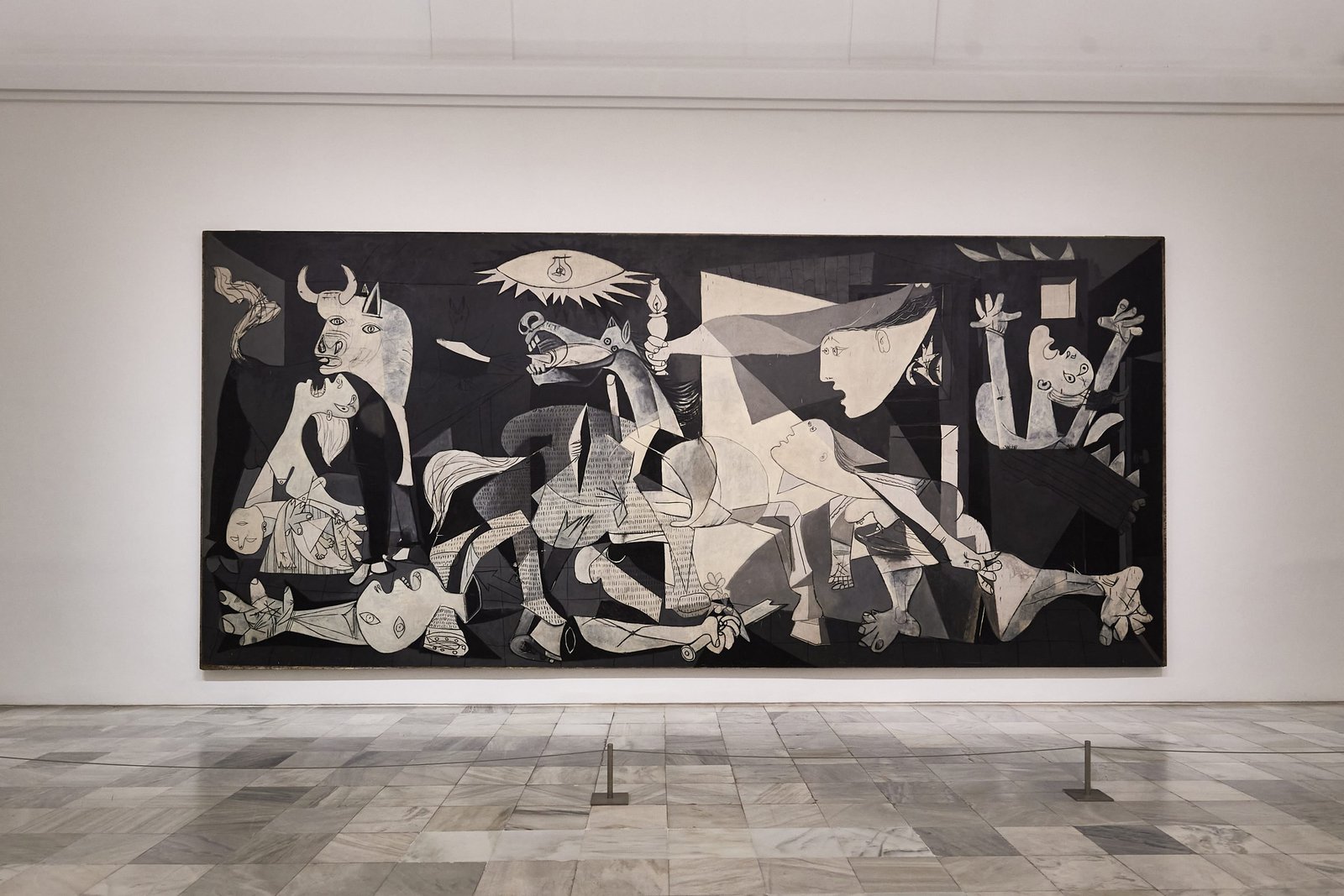
A political dispute has broken out over a possible loan of Picasso‘s Guernica, an icon of modern art that has not left Madrid in more than 40 years.
The row erupted in response to Madrid’s refusal to loan Guernica (1937) to the Guggenheim in Bilbao for a special exhibition this fall marking 90 years since the bombing of Guernica, a devastating event that inspired the mural-sized painting. Since the 1990s, the Basque government has made repeated requests to loan the work that have all been refused on account of its fragility. The work, which is currently housed at the Reina Sofia Museum, has not left Madrid since it arrived in 1981. At the center of the debate about its possible relocation is the question of how to weigh an artwork’s symbolic function against its conservation needs.
The high stakes of the dispute has seen it become politicized, resulting in a bitter back and forth between government officials in Madrid and the Basque country, one of Spain’s most autonomous communities. For Imanol Pradales, leader of the Basque National Party, it is a matter of pride that the painting be exhibited in the region. He has asked the Spanish prime minster Pedro Sánchez to support his cause, suggesting it would be “a serious political mistake” to ignore the issue, according to El País. Pradales’s party is one of several regional parties that currently support a government coalition led by Sanchez’s Socialist Party.
Madrid’s regional leader, Díaz Ayuso, meanwhile, has shot back at Pradales. She described the logic behind his demand as “parochial,” quipping that if art must return to its origin, then Picasso’s works should be transferred to his birthplace of Malaga. “I believe that culture is universal,” she said.
The Reina Sofia declined to comment on the dispute. Instead, it highlighted a report that it published on March 25, which had been commissioned by Spain’s ministry of culture in response to demands from the Basque government.
The report makes the case that the painting is too fragile to be relocated. A new analysis found that its “format” and “the nature of its component elements” make it particularly vulnerable to “all types of vibrations that are unavoidable during the transportation of works of art.” It warned against the possibility of damaging the paint layer, causing it to lift or crack.
A similar finding from 1997 has been cited on previous occasions that the Basque government has requested to loan Guernica. That earlier report claimed that the painting has already been rolled up and moved over 30 times in its history. All loan requests have been refused in recent decades, including one made by New York’s Museum of Modern Art in 2000.
Pablo Picasso’s Guernica being packed up at the Museum of Modern Art for shipment to Spain, 1981. Photo: Bettmann / Getty Images.
A spokesperson for the Basque government told El País that it had not requested a report on the painting’s condition, but rather “a report analyzing the conditions under which it would be possible to move it.” The ministry of culture has maintained that it cannot risk subjecting the national treasure to any damage.
The Guggenheim Bilbao declined to comment. Its proposed exhibition of Guernica would run for nine months from October 1 until June 30, 2027.
The colossal Guernica, which reaches over 25 feet in length, is perhaps art history’s most famous modernist depiction of war. The charged, monochromatic monument to human suffering was produced in response to an aerial attack on civilians in Guernica on April 26, 1937, by German and Italian forces. The event was emblematic of the violence of the Spanish Civil War.
Guernica holds a particularly prized position in Spain’s national collection, having only returned to home soil in 1981, in line with Picasso’s wish that democracy must first be restored. During the decades-long rule of Spanish dictator Franco, it remained at MoMA, which reluctantly gave up the treasure after years of negotiation. Now, it is an important symbol of Spain’s freedom.