
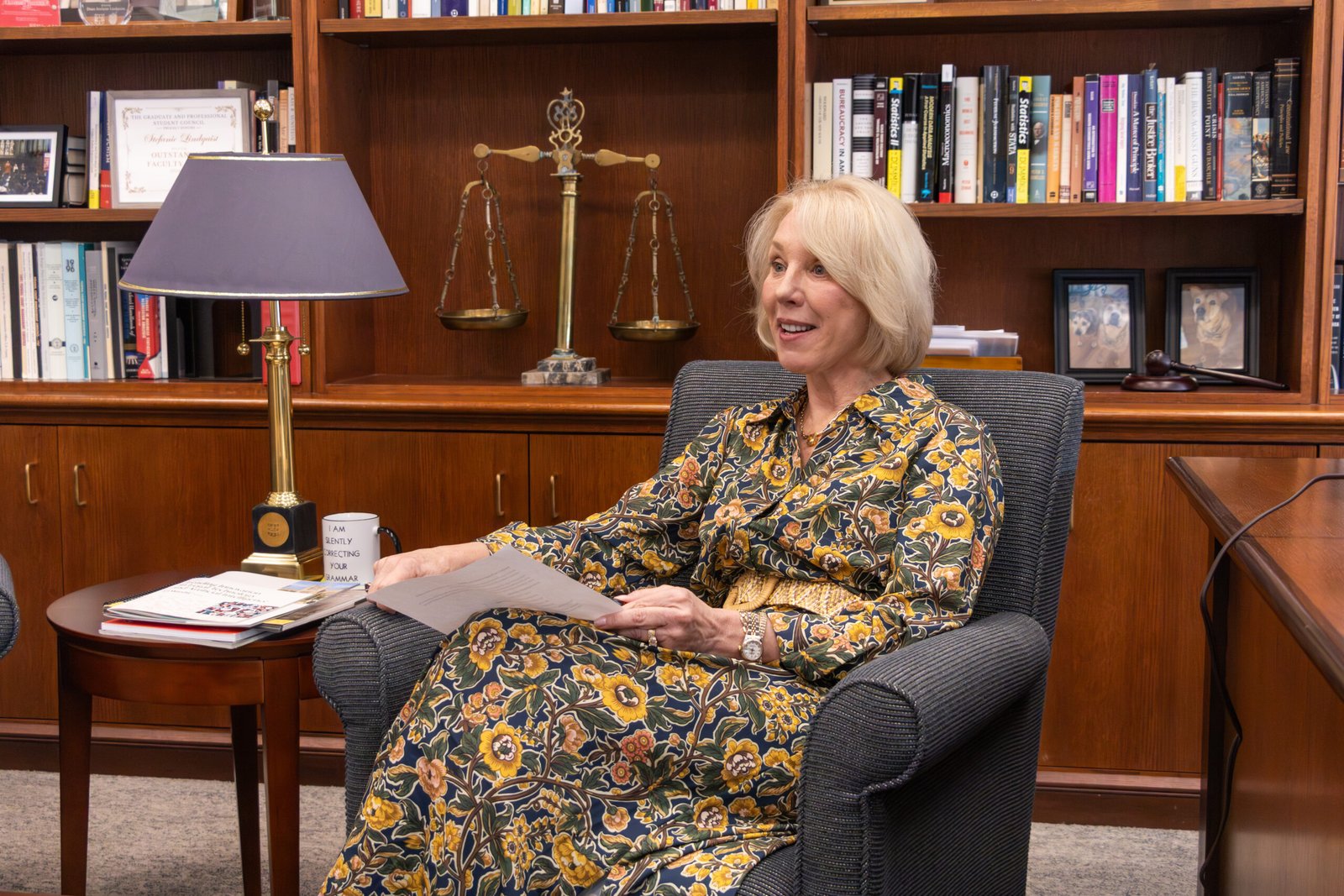
Dean of WashU Law Stefanie Lindquist explains WashU’s new loan program to offset caps on federal loans. (Bri Nitsberg | Managing Photo Editor)
WashU Law will begin to offer supplemental loans to law school applicants this upcoming fall. The loans, which will cover up to $25,000 per year and carry a 7.5% interest rate, will be guaranteed for students who have exhausted all other federal loan options.
WashU will be the first private law school to establish a private loan program and the second law school nationwide, the other being offered at the University of Kansas.
The decision to launch this program was made due to the newly established federal loan limits introduced in the One Big Beautiful Bill Act, as explained in a statement released by WashU Law.
“As federal student loan limits increasingly fall short of the full cost of a legal education, Washington University School of Law is launching a new supplemental loan program designed to help incoming JD students bridge the gap,” the statement reads.
Starting this summer, new federal regulations will limit incoming professional students, such as those studying law and medicine, to loans totalling to $50,000 per year and $200,000 per lifetime. Students attending graduate programs will be capped at $20,500 per year and $100,000 per lifetime. Loans taken out during undergraduate studies will count toward the lifetime limit. It is still unclear how professional and graduate caps will be distinguished from one another, especially among dual-degree students. Previously, federal loans could cover up to the price of attendance.
Senior Ari Appel, who plans to apply to law school in the coming years, said the loan program has the potential to create a broader positive impact by encouraging other schools to start their own.
“I think that WashU, as a leading law school, is setting an example by extending private loans to its students,” Appel said. “It is only going to make the world of law school more accessible, and it’s going to encourage more people to go to law school.”
Kelli Lively, director of Student & Parent Loan Programs, shared that the program will be funded and managed entirely internally. She declined to comment further.
“The new loan program is institutionally funded and administered entirely by WashU, from student awarding and entrance counseling, to preparing borrowers for repayment, and through to final loan payoff,” Lively wrote in an email to Student Life.
Stefanie Lindquist, dean of WashU Law, shared that the school started working on the program immediately after the One Big Beautiful Bill Act was signed into law.
“From the moment that the federal government announced caps on student loans for professional students, we immediately sprung into action to make sure that our students would have the resources necessary to complete their JD degrees,” Lindquist said.
Megan Peabody, the assistant dean of advising who advises pre-law students, said that she thinks that the federal loan caps could negatively affect the future of law by lessening the diversity of the field. In addition, she said it could skew the applicant pool toward older students.
“It’s going to be something that could, in the long term, change the landscape of who are people who are working in [law], which is a detriment to all of us,” Peabody said. “We should have a legal community that represents the people whom they’re defending or supporting, and this could end up creating this kind of bifurcated system.”
Peabody predicted that more prospective students will delay law school to save money for tuition.
“If anything, we’re going to see more and more gap years, because people need to be working, saving away money to be able to afford it, and then they’ll go to law school,” Peabody said.
The current WashU Law tuition is $75,600 per year, with approximately $30,000 of additional living expenses. While approximately 94% of students receive financial aid and/or merit scholarships, many students still rely on loans to cover the full cost of attendance. Lindquist said that the supplemental loan program aims to step in where public loans did previously.
“We have determined that there would definitely have been a gap if the federal student loans had been capped at [$]50,000 a year,” Lindquist said. “We assessed going forward what money we would need based on historical data.”
Peabody shared that these new caps have shifted the conversations that law advisors are having with applicants. While she has frequently discussed private loan options with international students who aren’t able to access public loans, the pre-law advising office has seen an increase in these conversations among domestic students since the loan caps were introduced.
Peabody explained that the office helps applicants navigate which private loans are safe with reasonable interest rates. She said that she sees the WashU loan program as a reliable option for students.
“The rate that they’re holding those private student loans at … feels like an appropriate rate,” Peabody said. “It’s not something that’s predatory. It feels like it’s something that’s safe.”
WashU’s supplemental loans will be ineligible for Public Service Loan Forgiveness (PSLF), a program that forgives the loans of lawyers who have served in the public sector for at least 10 years.
Eric Kubo, a third-year law student who works at the law admissions office, says that while he doesn’t think WashU Law students will be dissuaded from going into the public sector, the ineligibility of the supplemental program for PSLF will be another stressor for students to consider.
“It will definitely be part of the calculus that people have,” Kubo said. “People want to make sure that while they’re serving their communities, they’re also able to serve themselves.”