
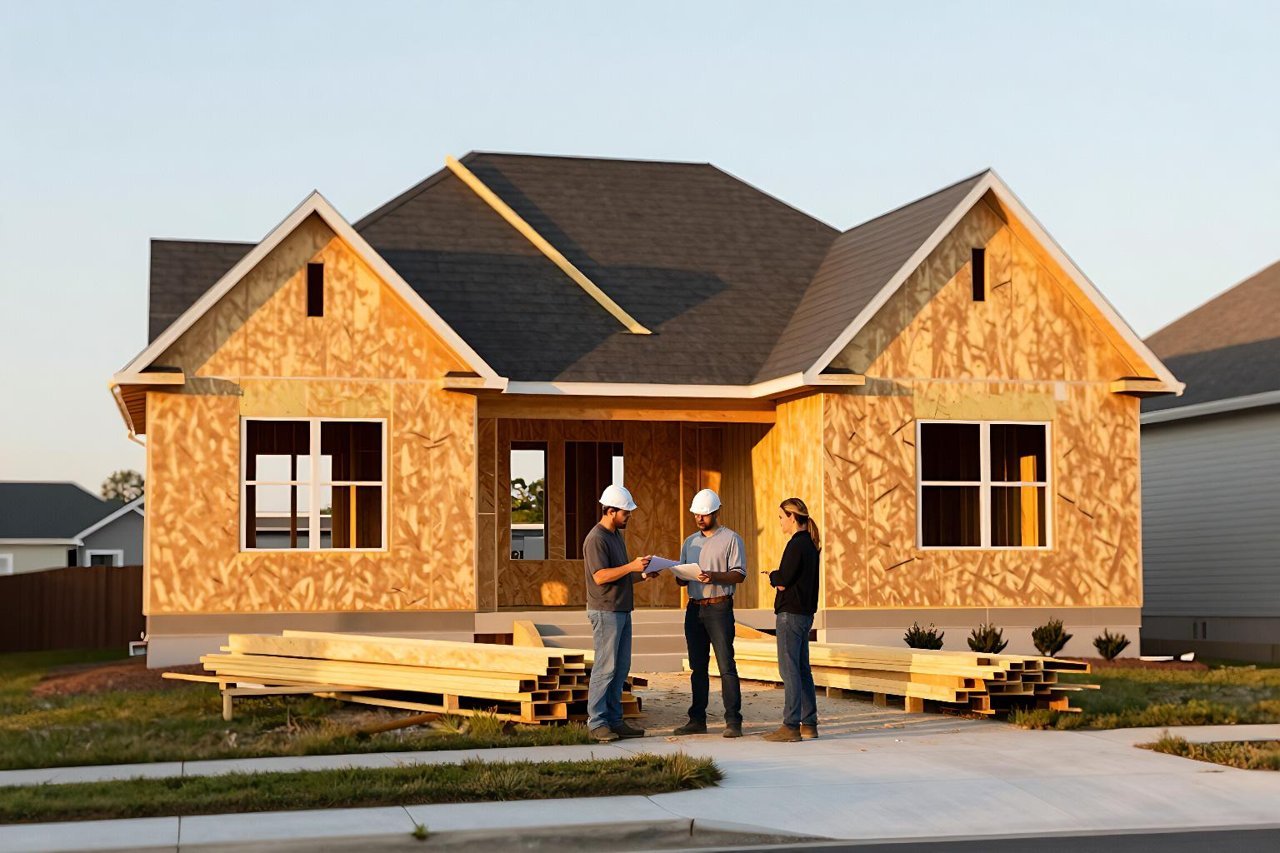
Building a house changes the mortgage conversation. You aren’t financing something you can walk through yet. The lender is underwriting a set of blueprints, a builder’s track record, and a timeline that can slip three months if the spring rains don’t let up. That’s why the best mortgage types for new construction homes look almost nothing like the standard 30-year loan you’d use on a resale property.
Get the structure right and you’ll pay interest only on the money actually drawn during the build, then slide into permanent financing without a second closing. Get it wrong and you can pay closing costs twice, watch a rate lock expire before the certificate of occupancy arrives, or scramble for a mortgage while the cabinets are going in. Knowing how to choose the right mortgage in today’s market matters more here than anywhere else, because the decision is nearly impossible to unwind once the foundation is poured.
Why new construction financing breaks the usual rules
Several things happen in a construction loan that never come up on a resale purchase:
- The appraisal is hypothetical. The appraiser values the home from plans, specifications, and comparable sales, not a finished structure they can inspect.
- Money is released in stages. The lender doesn’t hand the builder a check for $420,000 on day one.
- Your payment changes mid-stream. You start with interest-only payments on drawn funds, then convert to a fully amortizing payment.
- Lenders want a cushion. Most require a contingency reserve of 5% to 15% of the build cost to cover overruns, change orders, and material price swings.
The builder gets vetted too. Your lender will pull the contractor’s license history, insurance, and financials, and will often require the builder to be on an approved list. A contractor with three unfinished projects and a mechanic’s lien on the books is a red flag that ends an application fast.
Construction-to-permanent loans: the workhorse option
Also called a single-close or C2P loan, this is what most buyers building a custom home end up with. You apply once, pay one set of closing costs, and use one loan that starts as a construction line of credit and converts to a standard mortgage when the home is finished.
During the build, you typically pay interest only on the amount drawn, not on the full loan amount. Build a $500,000 house and draw $200,000 by month four, and you’re paying interest on that $200,000. Once you hit the conversion date, the balance amortizes over the term you chose, often 30 years.
How the draw schedule actually works
Lenders release money in stages, usually five to eight draws across a 9-to-12-month build. A typical sequence looks like foundation, framing and roofing, windows and mechanicals, insulation and drywall, then finishes. Each draw requires an inspection before funds are released, and the inspector works for the lender, not the builder. Expect a few days of lag between each request and each disbursement. Builders know this rhythm; first-time builders often don’t, which is where schedule arguments start.
One-close versus two-close
A two-close loan splits the transaction: a short-term construction loan, then a separate permanent mortgage when the home is done. You’ll pay two sets of closing costs, which on a $400,000 loan can run $8,000 to $14,000 combined, or roughly 2% to 3.5% of the loan each time. The upside is flexibility. If you expect rates to drop within a year, a two-close structure lets you shop the permanent loan later, and you’re not locked into whatever was priced 12 months before the house was finished.
FHA, VA, and USDA construction loans
Government-backed construction loans exist, and they’re worth checking if you qualify.
FHA one-time close
FHA’s construction-to-permanent product allows down payments as low as 3.5% with a 580 credit score, though most lenders posting competitive terms want 620 or better. The trade-offs are real: a 1.75% upfront mortgage insurance premium, annual MIP for the life of the loan in most cases, and a cap on how much seller or builder contribution you can receive.
VA construction loans
For eligible veterans, surviving spouses, and active-duty service members, VA construction financing requires no down payment and no monthly mortgage insurance. The catch is that VA-approved construction lenders are a smaller pool, and the builder generally has to be approved by the VA. You’ll also need a 10% contingency reserve in many cases, and VA caps how much of the loan can be drawn for certain items.
USDA construction loans
If the lot sits in an eligible rural area, USDA single-close construction loans offer zero down with a 1% upfront guarantee fee. Income limits apply and the definition of “rural” is narrower than most people expect, so check the eligibility map before you fall in love with a piece of land.
Jumbo and portfolio construction loans
Above the conforming limit, which sits just over $800,000 in most markets for 2025, you’re in jumbo territory. Jumbo construction loans usually want 10% to 20% down, six to twelve months of reserves, and a strong credit profile. Because jumbo construction volume is thin, these loans often stay on the bank’s own books, which means the terms vary wildly from one institution to the next. A local bank that lends on custom builds in your county may offer terms a national lender won’t touch. Comparing guides like Regions Bank’s mortgage programs and rate structures can help you calibrate what a portfolio lender typically charges versus a correspondent lender.
Builder-preferred lenders and the incentive game
Production builders almost always have a captive or preferred lender, and the pitch is seductive: $12,000 toward closing costs, a free rate buy-down, or upgraded countertops if you finance through them. Sometimes that’s genuinely the best deal on the table.Sometimes it isn’t. Builder credits often come with a rate 0.25% to 0.75% higher than what you’d find shopping independently, and the recapture language can claw back the credit if you refinance within two or three years. Brand recognition and glossy reviews tell you very little about whether a lender is right for your build; a lender’s star rating isn’t the same thing as a lender that fits your situation. Get a competing quote in writing, then use it as leverage. Plenty of builder lenders will match.
Lot loans and owner-builder financing
Some buyers purchase land first and build later. A lot loan is often a short-term, interest-only product with 20% to 30% down, and it can help you lock in land before prices climb. The risk is carrying two payments if the build takes longer than expected.
Owner-builder loans, where you act as your own general contractor, are the hardest to get. Very few lenders offer them, down payments start around 20% to 25%, and you’ll need a licensed subcontractor team locked in before closing. The savings can be substantial, but so is the exposure if a subcontractor walks off the job.
Where a digital-first lender fits
Online lenders have pushed into construction financing, and the appeal is obvious: faster document handling, fewer branch visits, and clearer tracking of where your file sits. If you’re managing a build from another state, that matters. A review of loanDepot’s digital mortgage process and rates is a useful reference point for what a well-run online experience looks like, though not every digital lender handles draw management as cleanly as it handles a standard purchase.
What underwriters dig into on a new build
Expect more paperwork than a resale purchase, and expect it earlier. Before approving a construction loan, most underwriters want:
- Signed builder contract with a fixed price and completion date
- Full plans, specs, and a line-item cost breakdown
- Proof of builder licensing, insurance, and completed projects
- Cash reserves covering the down payment plus contingency
- Extended rate lock, often 12 months, sometimes at a premium
- Confirmation that you’re within debt-to-income limits including the future payment, not the interest-only one
Because the permanent loan is underwritten at application, lenders run your credit and income before construction starts and often re-verify near the end. Taking a new car loan or changing jobs mid-build can derail a closing that took a year to set up. If you want a preview of the documentation lenders request, what homebuyers should know before applying is worth reading before you hand over bank statements.
Matching the loan type to your actual situation
There’s no single best mortgage type for new construction homes, only the one that matches your finances and tolerance for uncertainty. A few common pairings:
- Custom build, staying long term: single-close construction-to-permanent with a 12-month lock.
- Rates expected to fall within a year: two-close structure, then shop the permanent loan.
- Low down payment, first home: FHA one-time close or USDA in an eligible area.
- Veteran or active duty: VA construction loan with zero down.
- Build cost over $900,000: jumbo or portfolio construction loan through a local bank.
- Buying land now, building in two years: lot loan with a plan to refinance into construction financing later.
Questions worth asking before you sign anything
Ask your loan officer how many draws the loan allows and whether there’s a fee per draw, because some lenders charge $150 to $300 each time. Ask what happens if construction runs past the lock period, and whether you’ll pay an extension fee or float into whatever the market offers. Ask who pays for inspections during the build, since many loan estimates bury that in a line item.
Then ask the question that trips up more buyers than any other: what happens if the final appraisal comes in below the loan amount? On a new build, the appraiser has very little to compare against, and a low number means you cover the gap in cash or renegotiate with the builder. Get the answer in writing before the first shovel hits the dirt.