
Executive summary
India’s power sector is entering a decisive age in which the pace and shape of the energy transition will be determined as much by the structure of debt finance as by technology or policy. Meeting the Indian government’s target of 500 gigawatt (GW) of renewable energy capacity by 2030 will require a steep, sustained increase in capital expenditure (capex), dominated by wind and solar assets that require long-tenor, amortising debt. The sector’s ability to mobilise such debts at sustainable costs will ultimately determine whether India’s transition succeeds or stalls.
We have assessed the credit risk profiles of India’s eight key power generators — Adani Green Energy Limited (AGEL), Adani Power, JSW Energy Limited (JSWEL), ReNew Power, NLC India Limited (NLCIL), NTPC Limited, SJVN Limited, and Tata Power — which together account for around one-third of India’s installed capacity and span a broad spectrum of ownership structures and fuel mixes, ranging from renewable pure-play energy companies and coal-heavy generators to mixed portfolios. The analysis maps their current financial positions and capex plans to identify which transition strategies are creating financial advantages vis-a-vis emerging stress points. As expansion accelerates, all issuers face near-term credit pressure, making existing financial differentials increasingly consequential for sustainable growth.
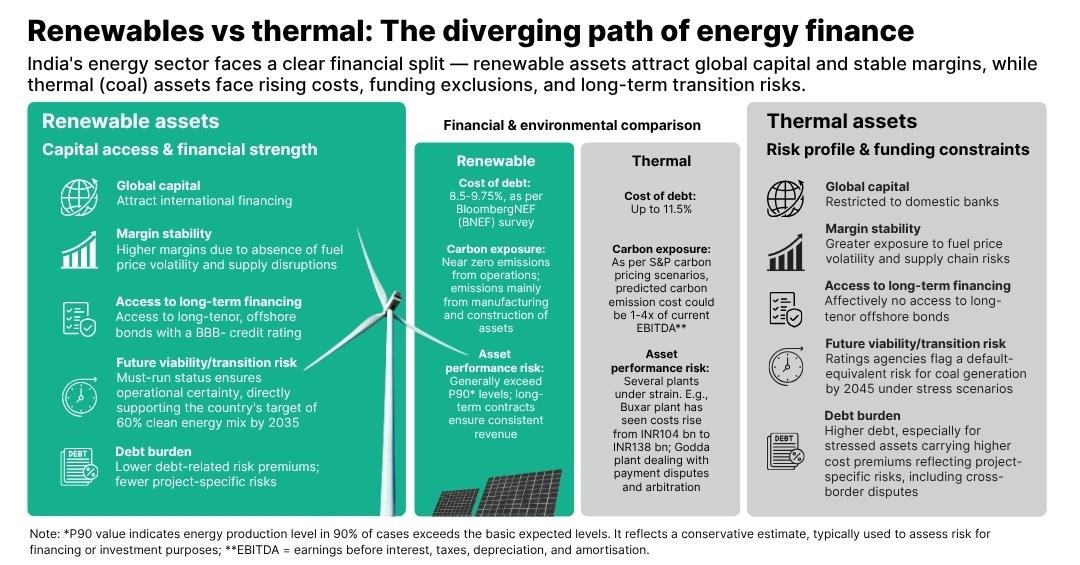
Renewable assets structurally outperform thermal on profitability. The absence of fuel costs gives renewable assets a durable margin advantage. AGEL consistently outperforms Adani Power on EBITDA margins within the same corporate group. Similarly, NTPC Green outperforms NTPC’s legacy thermal operations. These are not cyclical differences — they reflect a structural shift in the economics of power generation that will compound over time as renewable portfolios mature and generate stable, contracted cash flows.
Renewable expansion is already heavily debt-financed, and leverage will rise further. Renewable pure-plays carry the highest debt-to-capital ratios in the sector. Seven of the eight companies analysed generated negative free cash flow in FY2025, reflecting capital-intensive buildouts that are funded predominantly through debt. With announced capex, aggregate leverage will continue to climb, near-term credit metrics will deteriorate across the sector, regardless of the energy mix. The key question is whether the assets being built can support sustainable debt service over time.
Meanwhile, domestic bond market remains a structural bottleneck. Despite annual issuances exceeding USD500 billion (INR47 lakh crore) in 2025, India’s corporate bond market remains shallow with most of the growth being driven by public sector issuers. Issuances by the country’s utility sector have been uneven over the years, reflecting that India’s domestic debt market remains a relatively limited funding channel for corporates. The eight utilities analysed raise approximately 80% of their debt through loans, leaving significant untapped potential in bond markets as a financing channel.
Offshore bond markets offer a selective and fragile channel. Only renewable players are actively raising capital via USD-denominated bonds; thermal-linked credits are structurally absent, with Tata Power’s 2021 bond repayment marking an effective exit. Even within the renewable segment, issuance has been highly episodic and macro-sensitive. India sovereign rating — essentially an assessment of a country’s creditworthiness — receiving an upgrade in 2025 opens a potential re-entry point, enabling longer tenors and tighter spreads. But translating that into sustained offshore market access will require both issuer-level credit discipline and a degree of global funding stability that cannot be assumed.
A constructive macro window has opened and should be used. India’s sovereign credit rating upgrade by S&P and cumulative repo rate reductions to 5.25% as of February 2026 have created more favourable conditions for debt issuance. Tighter sovereign spreads, improving fiscal fundamentals, and the related rating uplift for NTPC and Tata Power collectively narrow corporate spreads and support access to longer-tenor, lower-cost financing — precisely the kind of debt that renewable infrastructure requires. This window should be actively exploited through catalytic issuances and blended finance structures designed to draw in private and international capital.
NTPC is central to unlocking transition finance. As India’s largest integrated power utility, 51.1% government-owned and rated on par with sovereign debt, NTPC carries both the institutional standing and the balance sheet scale to function as a pricing benchmark and anchor issuers across domestic, Masala, and international debt markets. Its INR7 trillion (USD80 billion) capex plan through FY2032 positions it as the single most consequential capital allocator in the sector. If NTPC can demonstrate credible transition planning, it would facilitate broader capital flows via a coherent transition finance agenda alongside other catalytic efforts.
How utilities scale up and allocate incremental capital in India’s energy systems will directly shape their transition risk, as well as their cost of capital and returns on investment. Done well, the transition could help strengthen debt capital markets, rather than be a source of systemic credit risk.