
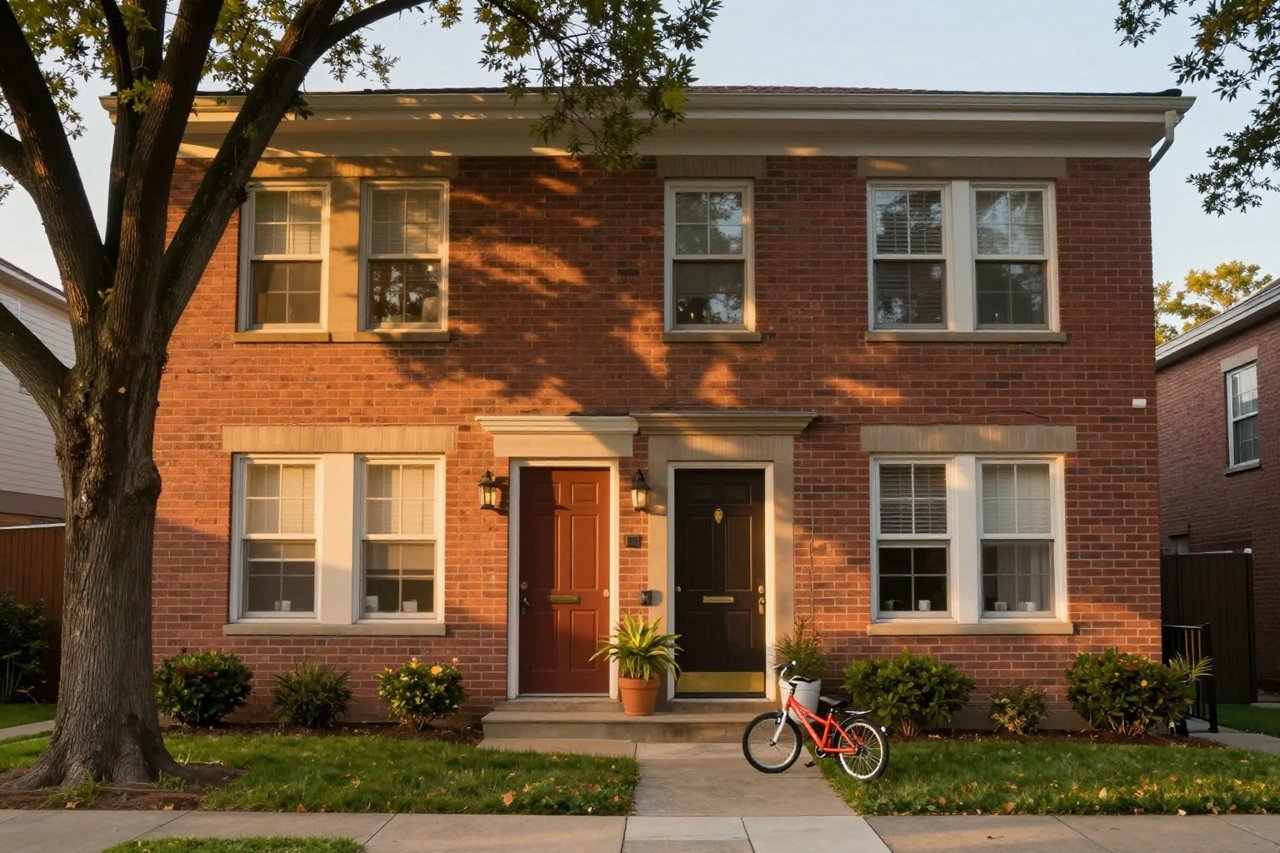
Two front doors, one mortgage. That’s the appeal of a duplex, and it’s why so many first-time buyers ask about an FHA loan for duplex purchases instead of saving for another three years. With 3.5% down and a credit score in the high 500s, you can buy a two-family building, live in one unit, and let a tenant cover a chunk of the payment.
The catch is that FHA has its own rulebook for two- to four-unit properties, and it’s stricter than most buyers expect. Follow it and a duplex becomes one of the cheapest ways into homeownership in an expensive market. Miss it and the deal dies at appraisal or in underwriting, usually after you’ve already paid for inspections.
The FHA rules that apply to a duplex
FHA insures mortgages on properties with one to four units, so a duplex qualifies, but only if you plan to live in it. At least one unit has to become your primary residence within 60 days of closing, and you sign a statement committing to occupy it for 12 months. Buying a duplex purely as a rental with an FHA loan isn’t allowed, and lenders do check. Tax returns, mail, your driver’s license and a post-closing occupancy verification all get examined.
Down payment is the headline number: 3.5% with a 580 middle credit score, or 10% if your score lands between 500 and 579. On a $400,000 duplex that’s $14,000 at the 3.5% tier, plus closing costs and reserves.
How rental income gets counted
FHA lets you use future rent from the units you won’t occupy, but only 75% of it. The 25% haircut is a vacancy and maintenance cushion. If the unit you’re not living in would rent for $1,500 a month, your lender credits $1,125 toward qualifying income.
Where does that rent figure come from? Not from your own estimate. The FHA appraiser completes a rent schedule (Form 1025) and gives an opinion of market rent for each unit. If the appraiser says $1,300 instead of $1,500, you lose $150 a month of qualifying power, which can push your debt-to-income ratio over the ceiling. It’s the single most common reason a duplex pre-approval shrinks after the appraisal comes back.
The self-sufficiency test skips duplexes
This one trips people up in both directions. FHA requires rents to cover the full mortgage payment, including taxes and insurance, for three- and four-unit properties. Duplexes are exempt from that test. If you’re weighing a two-unit against a triplex, the difference can decide which one you can actually afford, because the triplex has to stand on its rental income alone.
One more wrinkle: you can’t claim rent for the unit you occupy. Obvious once you say it aloud, but it shows up as a surprise on the qualifying worksheet for a lot of first-time buyers.
Loan limits matter more than you’d think
FHA mortgages are capped, and the cap varies by county. Two- to four-unit properties get a higher maximum than a single-family home in the same county, which is why some buyers shopping near the ceiling find that a duplex fits their budget while the house down the street doesn’t. For 2025 the national floor sits at $524,225, with a ceiling above $1.2 million in the priciest markets.
Check your county’s number before you tour anything. Understanding how the FHA mortgage loan limit works can save you from writing an offer on a building that can’t be financed the way you planned.
Credit, DTI, and the numbers underwriters stare at
FHA is forgiving on credit but not on capacity. Most lenders want total debt-to-income at or under 50%, and rental income counted at 75% is already a conservative input. Student loans, car payments and any debt you co-signed for all count against you, even if someone else makes the payments.
Two features help duplex buyers specifically. Gift funds are allowed for the entire down payment and closing costs as long as you document the transfer and the donor’s relationship. FHA also permits non-occupant co-borrowers in certain scenarios, which lets a parent help with qualifying on a property they’ll never live in.
The appraisal is where duplex deals die
FHA appraisals aren’t just valuations. They’re condition inspections, and older two-family buildings fail on small, fixable things that still cost you weeks.
- Peeling interior or exterior paint on homes built before 1978
- Missing handrails on stairways with more than two risers
- A roof near the end of its life or showing visible damage
- Utilities shut off at inspection, which stops the appraiser from testing systems
- Crawl space moisture, exposed wiring, or a water heater missing its pressure relief pipe
None of these kill a deal outright if the seller agrees to repairs, but each one is a renegotiation and a delay. Read the FHA loan inspection requirements before your offer goes in and walk the property with that list in hand. On a duplex you’re also inheriting tenants, so request the leases and estoppel letters early, ideally before the inspection period ends.
FHA versus conventional on a duplex
Conventional lenders price duplexes differently than single-family homes. Expect 15% down for a two-unit primary residence, versus 3% or 5% on a house, plus tighter credit requirements and reserves. A duplex buyer with a 760 score and 15% to put down often finds conventional cheaper once mortgage insurance is priced in, particularly because FHA mortgage insurance typically lasts the life of the loan.
If your score is 620 and cash is thin, FHA wins on nearly every measure. The FHA versus conventional comparison usually comes down to three inputs: cash available, middle credit score, and how long you plan to keep the property.
Where buyers typically get it wrong
- Assuming a verbal rent estimate counts. It doesn’t; the appraiser’s rent schedule rules.
- Forgetting that a two-unit with a non-permitted basement conversion may be treated as a three-unit property.
- Buying as an investment while calling it a primary residence. Occupancy fraud carries real consequences.
- Skipping reserves, usually one to two months of payments left over after closing.
- Ignoring the rented unit’s condition. A rough tenant unit can fail the appraisal even if your side is pristine.
A quick worked example
Say the duplex is $420,000 in a county where the FHA limit allows it. You put 3.5% down, which is $14,700, and finance $405,300. At 6.5%, principal and interest run about $2,562 a month. Taxes and insurance add roughly $650, so the full payment lands near $3,212. The appraiser says the vacant unit rents for $1,600, so $1,200 counts as income. Subtract that and you’re qualifying against about $2,012 a month, close to the payment on a $250,000 house in the same market. That gap is the entire argument for a duplex.
When a portfolio lender or multi-family loan fits better
Not every duplex scenario slides neatly into FHA. If you’ve already used your FHA entitlement on a prior home, if a unit needs renovation before it will pass appraisal, or if you want 100% of rents counted rather than 75%, a portfolio mortgage held by the lender can be more flexible, because that lender writes its own guidelines instead of following HUD’s. Investors buying two- to four-unit buildings as pure rentals should start with the multi-family mortgage guide, which covers DSCR loans that underwrite on the property’s income alone rather than yours.
What to have ready before you call a lender
The buyers who close on duplexes quickly tend to be the ones who show up prepared. Have these ready and a pre-approval can move in days rather than weeks:
- Two years of tax returns and W-2s, plus current pay stubs covering 30 days
- Two months of bank and retirement statements, with any large deposits sourced
- Gift letters and transfer records if family is helping with the down payment
- A rough target for the rent you expect, so the lender can model the 75% income credit
- Your county’s FHA loan limit and a realistic price range built around it
Ask the loan officer one direct question before you commit: how many FHA duplex loans did you close in the last twelve months? Underwriters who rarely see two-unit files routinely misread the rent schedule, the self-sufficiency exemption, or the occupancy documentation. A lender who has done it before will spot the problem while there’s still time to fix it.