
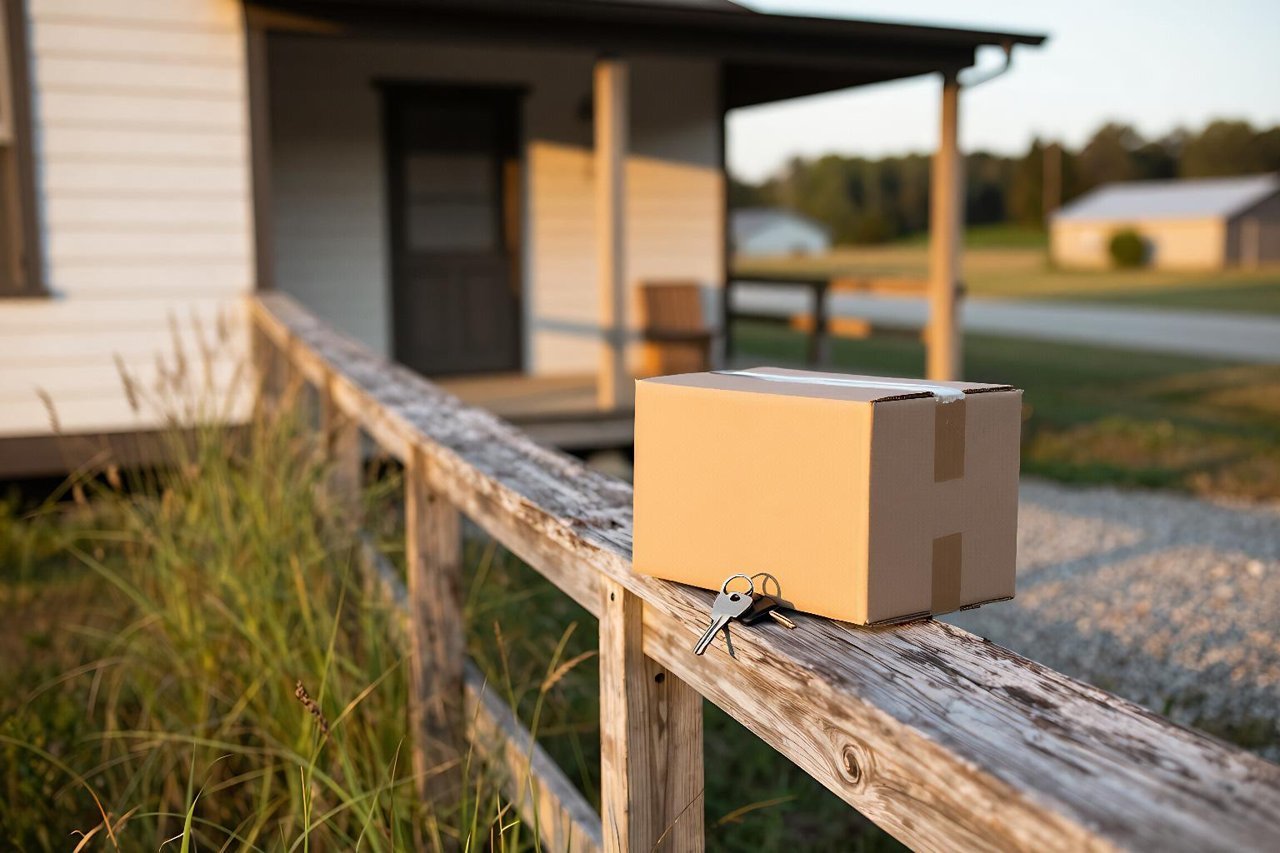
Picture a three-bedroom ranch on a half acre in a town of about 6,000 people, thirty minutes from a mid-size city. List price: $215,000. A buyer with $8,000 saved can put 3.5% down on an FHA loan, or buy the same house with nothing down on a USDA loan and keep most of that money in the bank. That gap is the entire reason the program exists, and it is why the order in which you do things matters more here than with almost any other loan type.
Here is the whole process, step by step, with the numbers you will actually see.
Step 1: Confirm the Address Qualifies Before You Fall in Love With the House
USDA eligibility attaches to the property, not to you. The program covers rural areas, generally open country or towns under 35,000 people, and the boundaries are drawn block by block from census data. Two houses on the same street can get different answers. So can two houses in the same subdivision if the map line runs between them.
Open the USDA’s property eligibility map, type in the full street address, and screenshot the result. Do this before the showing, not after the offer. Boundaries shift after every census, so a neighborhood that qualified in 2018 may have quietly dropped off, and plenty of homes just beyond a city limit — long driveway, well and septic, nearest neighbor half a mile away — are fully eligible. If you are weighing this against other options, it helps to understand how USDA stacks up against VA, FHA, and local portfolio lenders in rural markets before you commit to a search radius.
Step 2: Run the Household Income Test
This is the step that trips up the most otherwise-qualified buyers. The USDA income cap is based on everyone who will live in the house, not just the people signing the note. A roommate, an adult child back from college, a parent moving in — all of it counts toward the household figure, even if only one person is on the loan.
For guaranteed loans the ceiling is generally 115% of the area median income, adjusted for family size. Across most rural counties that lands somewhere between roughly $110,000 and $140,000 for a one-to-four-person household, with high-cost states running well above that. Check your specific county limit rather than assuming. If your household income is comfortably under the cap and your credit is decent, you are looking at one of the most overlooked zero-down mortgages available to American buyers.
Guaranteed vs. Direct: Same Agency, Very Different Rules
The guaranteed program is what almost everyone uses. A normal lender originates the loan, USDA backs 90% of the lender’s loss, and processing looks a lot like a conventional mortgage. The direct program is funded by USDA itself, aimed at low and very low income households, and can include a payment subsidy that drops the effective rate as low as 1%. It can also take several months to process. If your income sits near the bottom of the local scale, ask about direct before you assume guaranteed is your only route.
Step 3: Get Your Credit and Debt Numbers Into USDA Shape
There is no official minimum credit score written into the USDA handbook. In practice, lenders want around a 640 to get an automated approval through GUS, the agency’s underwriting engine. A few will go to 620. Below that, your file goes to manual underwriting, where you will need compensating factors: twelve months of on-time rent, a long employment history, cash reserves, or a low housing payment relative to income.
On debt, GUS typically approves up to a 41% debt-to-income ratio, stretching to 46% with strong compensating factors. That is tighter than a lot of people expect. A $600 truck payment and $300 in minimum card payments eats a real chunk of a $70,000 salary. Pay down revolving balances and avoid financing a car in the six months before you apply. If your scores land in the 580 to 620 range, an FHA loan with 3.5% down may be the more realistic path.
Step 4: Assemble the File Before You Shop
USDA files get scrutinized more than conventional ones because the agency reviews the final package. Have this ready in a folder, digital or otherwise:
- Two years of federal tax returns, all schedules, plus W-2s for the last two years
- Thirty days of pay stubs covering the most recent month
- Two months of bank statements, every page, including blank ones
- Photo ID and Social Security numbers for every adult household member
- Documentation for any gift funds, plus a signed gift letter from the donor
- Proof of any other household income, including child support or Social Security awards
Self-employed buyers need two full years of returns plus a year-to-date profit and loss statement. If you have changed jobs recently, expect questions — USDA wants stable, verifiable income.
Step 5: Get Pre-Approved Through a USDA-Approved Lender
Not every lender offers USDA loans, and the ones that do range from fast to glacial. Ask two questions up front: how many USDA loans did you close last year, and who submits to GUS? A lender who handles a handful a year will slow you down on appraisal and repair issues. The document-gathering rhythm here is similar to the pay-stub-to-closing-table steps on a conventional mortgage, with an extra layer of agency review at the end.
Pre-approval through GUS usually comes back in a day or two once your file is complete. That letter is what sellers take seriously in rural markets where USDA offers are common.
Step 6: Make an Offer With the Right Contingencies
Keep three contingencies: inspection, appraisal, and financing. USDA deals fall apart at the appraisal and inspection stages more often than anywhere else, and a tight timeline with no outs is how buyers lose earnest money.
Sellers can contribute up to 6% of the purchase price toward your closing costs, which is often enough to cover the whole bill. Gift funds from family are allowed, and there is no rule requiring you to have any of your own money in the deal. That said, if your finances are tight enough that every dollar has to come from somewhere else, it is worth reading up on the realistic no-down-payment routes and where each one breaks down.
Step 7: Inspection, Well and Septic Testing, and the Appraisal
The USDA appraisal is not just a value opinion. The appraiser checks the home against minimum property requirements, and anything flagged has to be fixed before closing — by the seller, in almost every case. Common killers include peeling exterior paint on pre-1978 homes, missing stair or deck handrails, exposed wiring, a roof with under two years of life left, and active roof or foundation leaks.
If the property has a private well or septic system, expect water testing for bacteria and nitrates, and a septic inspection. Budget two to three weeks for this stage alone. Sellers who refuse repairs are not necessarily being difficult; they may just not want to repaint a whole house in three weeks. Either way, know the list before you go under contract so you can price the risk into your offer.
Step 8: Underwriting, Conditional Commitment, and Closing
Once the appraisal and title work are in, your lender submits the full package to USDA for a conditional commitment. That review typically takes three to seven business days, sometimes a bit more at peak season. After the commitment comes the closing disclosure, a final walkthrough, and signing. Total timeline from accepted offer to keys is usually 30 to 45 days on a guaranteed loan, and considerably longer on a direct loan.
What the Monthly Numbers Actually Look Like
Take that $215,000 house with zero down. The upfront guarantee fee is 1% of the loan, or $2,150, and it gets financed rather than paid in cash, bringing the loan to $217,150. At a 6.5% rate over 30 years:
- Principal and interest: about $1,373
- USDA annual fee of 0.35% on the outstanding balance: about $63 in year one
- Property taxes and homeowners insurance: roughly $310
- Total: about $1,746 a month
Compare that to the same house on an FHA loan with 3.5% down. You would need about $7,525 at closing plus costs, and you would carry 0.55% annual mortgage insurance premium instead of the 0.35% USDA fee. The monthly payments land within a few dollars of each other. The difference is the seven and a half grand, which stays in your account on the USDA version. If that comparison is the one that decides things for you, there is more on low down payment options for buyers without 20% saved.
Where USDA Deals Quietly Fall Apart
Almost every failed USDA purchase traces back to one of five mistakes, and each one is avoidable:
- Falling for a house outside the eligible map and finding out after the inspection period expires
- Adding a co-borrower or household member whose income pushes the group over the county limit
- Skipping the eligibility map check because a real estate agent said the area qualifies
- Assuming the seller will handle every repair on the appraisal list without negotiating it into the offer
- Choosing a lender with thin USDA experience and losing three weeks to a resubmission
None of these are hard to prevent. Check the address first, run the household income math second, and keep a lender who has done this before on speed dial. Do those three things and the rest of the process behaves like any other mortgage — just with a smaller number on the down payment line.