
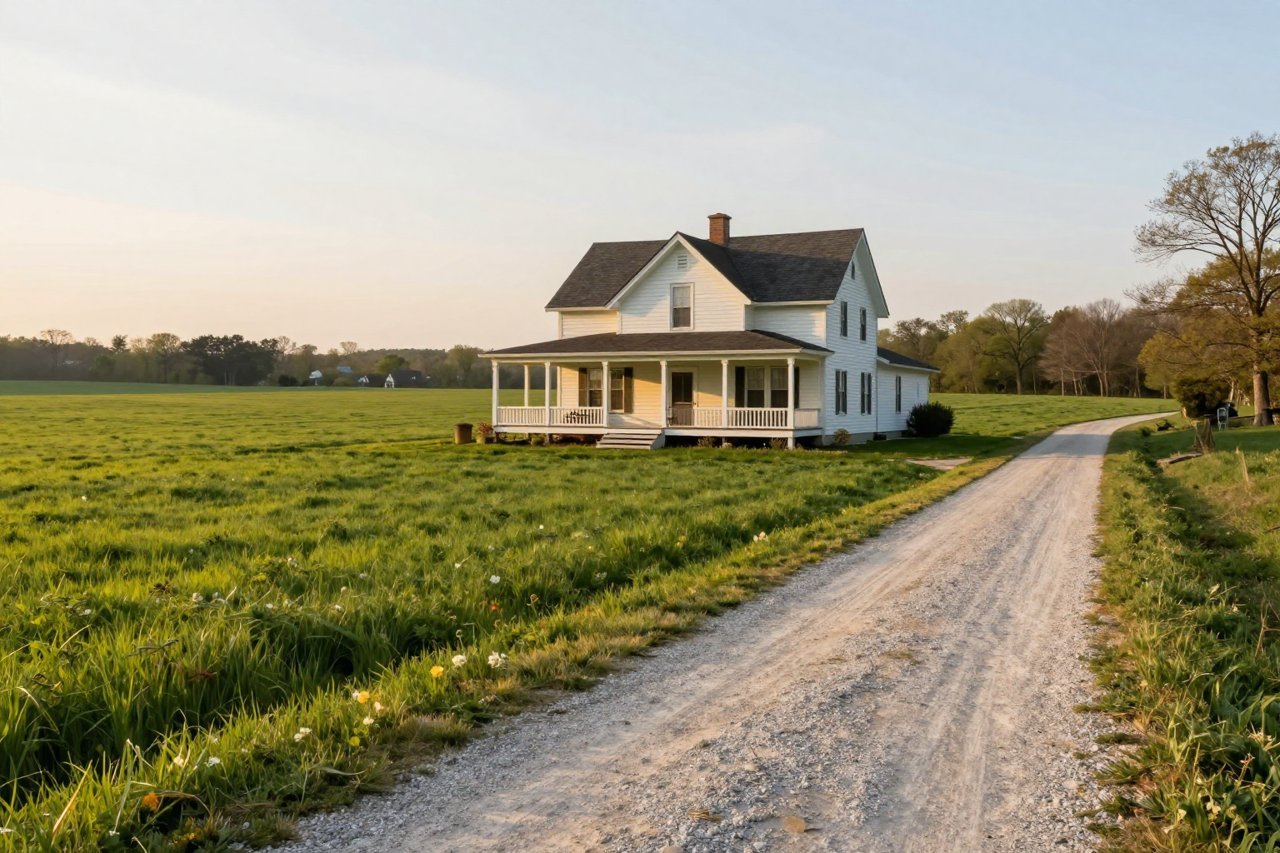
There’s a certain quiet that settles over a house at the end of a gravel road. The stars are brighter. The nearest neighbor isn’t in sight. But when you sit down to finance a rural property, you quickly realize that the mortgage process isn’t the same as buying in a subdivision.
Lenders handle country homes differently. They worry about well and septic systems, access roads, and whether your 10 acres will actually appraise for what you’re paying. That’s why it helps to understand exactly how a rural home mortgage works before you make an offer.
What Counts as a “Rural” Home for Mortgage Purposes?
There isn’t one universal definition. The U.S. Department of Agriculture, for instance, maps out eligible areas based on population density. For a USDA rural home mortgage, your property generally needs to be in a town with fewer than 35,000 residents, though the exact boundary can put a home just outside a suburb into the “eligible” category.
Fannie Mae and Freddie Mac look at things differently. They focus on the property’s characteristics. A home with a large lot or a property that touches agricultural land may still qualify for a conventional loan if the house itself is the primary structure and the land isn’t used for income-producing farming.
The key distinction: a rural home mortgage typically covers a primary residence that happens to be surrounded by fields, forests, or grazing land. Once you start talking about commercial farming or livestock operations, you’re moving into agricultural mortgage territory, which has its own set of rules.
Rural Home Mortgage Programs You Should Know About
USDA Section 502 Direct and Guaranteed Loans
The USDA is one of the biggest players in rural home financing. The guaranteed loan program lets you borrow up to 100% of the property’s appraised value, which means a zero down payment is possible in many cases. These loans are available to low- and moderate-income buyers, and the interest rate depends on your income level and market conditions.
To qualify, the home must be in a USDA-eligible area, the property must be your primary residence, and your household income can’t exceed 115% of the median income for that county. For a family of four in rural Missouri, that limit might be around $89,000, while the same family in a rural part of California could see a cap closer to $120,000.
FHA Loans on Rural Properties
If you’re not income-eligible for USDA financing, an FHA loan is a strong fallback. With a 3.5% down payment and a credit score floor of 580, FHA is more forgiving of small dings on your credit history.
The catch is that FHA appraisers are strict about property condition. The house needs adequate water supply, a functioning septic system that passes inspection, and safe access from a public road. If your dream property has a shared driveway with an easement, the lender will want to see clear documentation that the easement can’t be revoked.
Conventional Loans With a Larger Land Component
Conventional mortgages allow rural homes, but the land restrictions are tight. Most lenders won’t let a house sit on more than 10 acres and still treat the purchase as a standard owner-occupied loan. If you’re looking at 40 acres of mixed pasture and woodland, the appraiser will need to justify the value based on the home and the residential site, not the potential for cattle grazing.
A good rule of thumb: if you plan to farm the land or generate income from it, tell the lender upfront. Many buyers try to stretch the truth and later find out their conventional loan requires the land to remain non-agricultural. In that case, a farm mortgage might be the better fit from day one.
The Hidden Obstacles in Rural Home Financing
Access, Utilities, and Seasonal Roads
City buyers never think about a road that turns to mud in March. Rural lenders do. If a property relies on a seasonal access road, many lenders will demand a year-round access guarantee. That could mean a recorded road maintenance agreement or a shared private road easement that satisfies the title company.
Well and septic issues are another common deal killer. A loan on a home with an outdated septic tank won’t move forward until the system is replaced or repaired. Depending on your state, that can cost anywhere from $5,000 to $30,000. You can write an offer that asks the seller to handle it, but be prepared for the negotiation.
Appraisal Challenges in Sparsely Populated Areas
Your friendly suburban appraiser can always find three recent comparable sales within half a mile. In rural counties, that’s rarely the case. Appraisers have to look farther back in time and much wider in geography, which means a home’s value can swing dramatically depending on what sold last.
If you’re buying a unique rural property—say a handcrafted timber frame house with solar and a septic system—the appraiser may struggle to find anything similar. This is where a local lender with rural expertise is worth their weight in gold. They know which appraisers understand farms, outbuildings, and land value.
Should You Finance Land and House Together?
Many rural buyers aren’t purchasing an existing home at all. They’re buying a plot of land and planning to build, or they’re purchasing a house with enough acreage for a workshop, garden, and maybe a few animals.
If the land and home are sold as one package, a traditional rural home mortgage can usually cover both, provided the lot isn’t excessively large. But when you own the land outright and need to construct a new home, lenders treat that as a construction loan, not a standard mortgage. Construction loans carry higher rates and require a detailed plan, a builder, and a timeline. If you’re in this situation, it helps to understand how a lot loan mortgage differs from a construction loan, especially if you need to buy the land before the building process begins.
The same logic applies to modular home financing. Many rural homeowners save money by having a prefabricated home delivered and assembled on their property. But not every lender treats modular homes the same as stick-built houses. You’ll need a lender who understands how to finance the combined cost of the land, the manufactured unit, and the site work.
Down Payments and Credit Requirements in Rural Areas
It’s easy to dream about a $30,000 down payment, but rural home buyers often have options. USDA guaranteed loans are the standout because they allow 100% financing. If you have a slightly higher income but a thin down payment, some lenders in rural areas still offer 97% financing on conventional loans based on local market incentives.
Credit requirements are fairly standard across the board these days. FHA loans will go down to 580, USDA often expects a 640 or higher depending on the lender, and conventional loans typically want a 620. If your score is lower than that, you’ll probably need to work with a lender who offers manual underwriting, which looks at your rent payment history and other compensating factors.
A bright spot is that rural properties often come with a lower purchase price than their suburban counterparts. The median price of a home on 5 or more acres in the Midwest is frequently $200,000–$350,000, compared to similar square footage near a metro area at $450,000 or more. The trade-off is that you’ll spend more on fuel, maintenance, and maybe a new well pump.
Understanding Property Eligibility Before You Make an Offer
Before you fall in love with a rural listing, run a quick USDA eligibility search on the address. It’s a free tool, and it takes about thirty seconds. But eligibility isn’t the same as financing feasibility. You also need a conventional residential appraisal, a clear title, and no outstanding liens on the property.
Buyers should also check zoning laws. If you purchase a home on 15 acres in a county that allows agricultural operations, that’s not automatically a problem for a mortgage. But if you later decide to raise hogs for sale, your property may be reclassified from residential to agricultural, which could trigger different insurance requirements or even a land-use change notice from the county assessor.
Questions to Ask Before Signing a Rural Home Mortgage
Not every lender understands rural property quirks. Before you commit, ask a prospective lender these specific questions:
- Do you have experience underwriting homes on wells, septic, and shared private roads?
- Have you closed loans in my target county before?
- Will the appraisal consider outbuildings like barns and detached garages as part of the value?
- Are there any acreage limits or land use restrictions on the loan program you recommend?
- How do you handle rural properties that are partially fenced or zoned for light agriculture?
If the lender gives you vague answers to any of these, move on. A rural home mortgage is only smooth when your loan officer has actually walked a gravel driveway to inspect a property.
Financing a home beyond the city line requires more legwork, but the tools exist to make it realistic. Whether you’re looking at a cozy cottage on an acre or a ranch house overlooking fifty acres of open land, the right mortgage starts with knowing exactly what kind of property you’re buying and how your lender will view it.